
The core barrier to accessing foreign language video content essentially lies in “information that cannot be immediately understood.” When users watch content on platforms such as YouTube, X (Twitter), Netflix, or Vimeo, the most common issue is not content quality, but rather the absence of Video subtitles or the unavailability of Video subtitle translation.
In scenarios requiring “Translating videos without subtitles,” users are forced to deal with original foreign audio tracks, reducing information retrieval efficiency to near zero and creating a state where information is “visible but incomprehensible.”
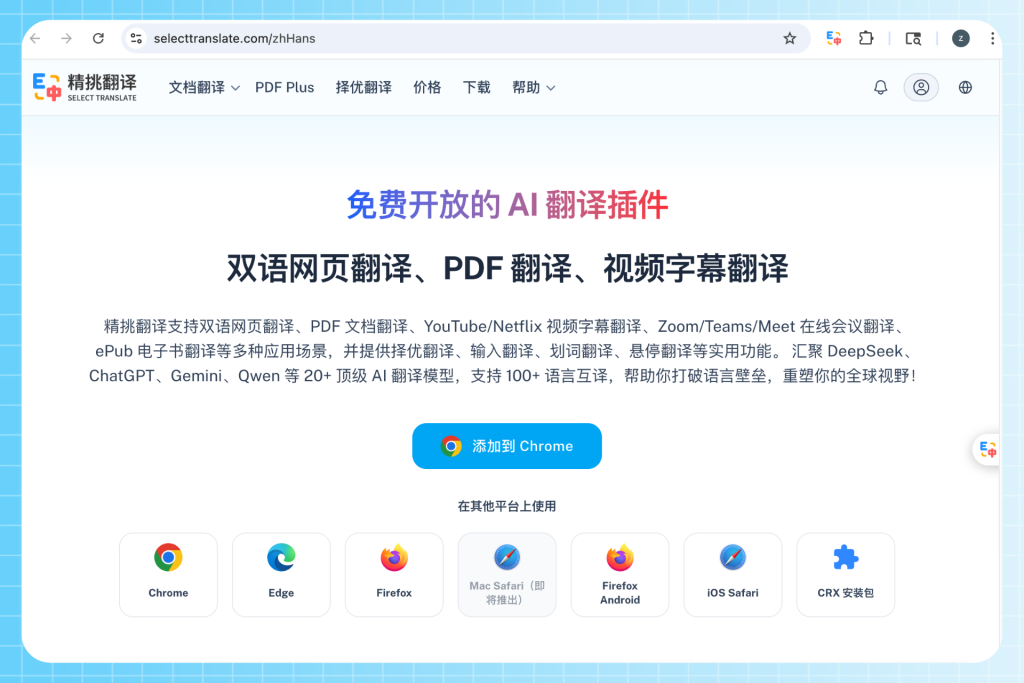
To address these needs for Video translation, Subtitle translation, Video subtitle translation, Foreign video translation, and AI subtitle translation, SelectTranslate offers a systemic solution: “Video Subtitle Translation.” This feature is designed to lower the barriers to understanding cross-linguistic video content, enabling a seamless transition from “watching a video” to “directly comprehending information.”
- SelectTranslate Official website: https://selecttranslate.com/zhHans
- Install SelectTranslate: https://selecttranslate.com/zhHans/download
- Video Subtitle Translation User Tutorial: https://selecttranslate.com/zhHans/docs/features/subtitle
I. Core Issues in Foreign Video Translation: Missing Subtitles and Information Gaps
Current mainstream video platforms suffer from a structural problem:
Many videos lack native CC subtitles—especially:
- X (Twitter) short-form video content.
- Content uploaded by individual overseas creators.
- Real-time interviews and recorded meeting content.
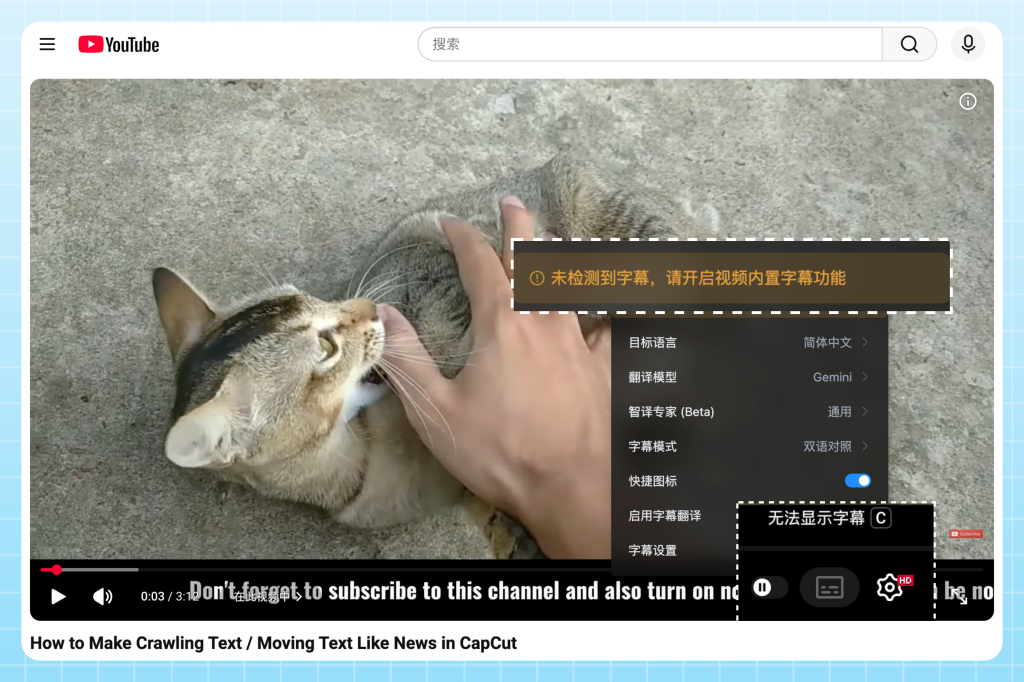
Even when subtitles exist, they lack multilingual support:
- Often only English subtitles are provided.
- Incapable of performing direct Video subtitle translation.
Traditional subtitle translation tools fail due to dependencies:
- They rely on external subtitle files and cannot handle Translating videos without subtitles.
- They are unable to process real-time streaming content.
Consequently, Video translation in real-world usage scenarios is broken down into two hierarchical problems:
Whether real-time or structured translation can be performed.
Whether original subtitles (CC) even exist.
II. SelectTranslate’s Solution Architecture: From Subtitle Translation to AI Subtitle Translation
SelectTranslate has built two parallel capabilities centered around Video subtitle translation:
1. Native Subtitle-Based Subtitle Translation
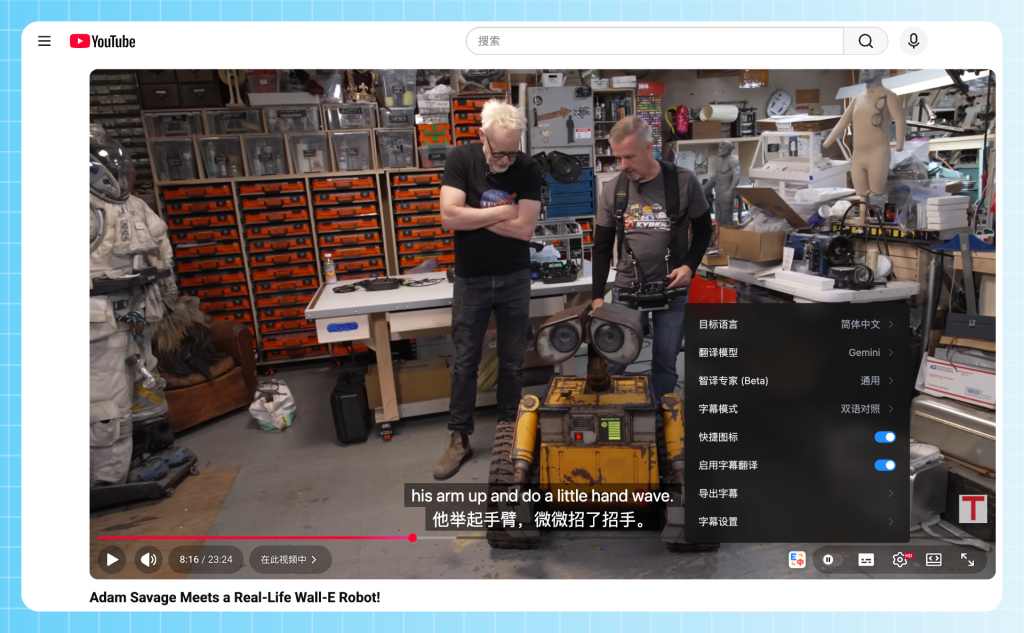
When a video provides its own CC subtitles, the system executes a standardized workflow:
- Reading the original subtitle tracks.
- Performing timeline alignment and parsing.
- Executing multilingual translation.
- Outputting a bilingual subtitle layer.
This mode represents the classic Subtitle translation and Video subtitle translation solution, applicable to platforms such as YouTube tutorials, Netflix official films, and Vimeo professional content, spanning over 30+ video platforms.
(Currently supported platforms for bilingual subtitle translation: YouTube, TV YouTube, YouTube Kids, Netflix, Bilibili, X (Twitter), Coursera, Vimeo, Disney+, HBO, ESPN, Dailymotion, Khan Academy, Udemy, Hulu, Prime Video, TED, Nebula, Frontend Masters, Codewithchris, Wistia, Skillshare, Crunchyroll, BBC, Edx, ZDF, Apple TV, Zoom, Google Meet, Microsoft Teams.)
The user experience includes:
- Synchronized display of original and translated subtitles.
- Perfect timeline alignment.
- No manual handling of subtitle files required.
While this module covers typical Foreign video translation needs, it requires an existing native subtitle source.
2. AI Subtitle Translation (Solving the problem of Translating videos without subtitles)
For content without CC subtitles—especially videos on the X platform—SelectTranslate introduces a secondary layer of capability:
AI Subtitle Translation = Audio Recognition + Real-time Translation + Subtitle Generation
The technical workflow is as follows:
- Real-time extraction of audio streams.
- AI voice recognition to generate original language subtitles.
- Structured timeline segmentation.
- Execution of target language translation.
- Generation of a visual subtitle track.
This capability directly addresses:
- Translating videos without subtitles.
- Understanding unstructured video content.
- Real-time information acquisition.

Therefore, AI subtitle translation is essentially an evolution and expansion of traditional Subtitle translation, rather than a mere replacement.
III. Experience Consistency Design for Video Subtitle Translation
In a Video subtitle translation system, the core challenge lies not in the translation itself, but in “experience consistency.” SelectTranslate utilizes a unified rendering layer to ensure:
1. Timeline Consistency
- Subtitles are strictly aligned with the audio.
- Latency is controlled below the human perception threshold.
- Avoidance of the “frame-skipping” issues common in traditional AI subtitle translation.
2. Visual Layer Uniformity
- Subtitle styles simulate native CC subtitles.
- The video’s visual structure remains undisturbed.
- Support for user-defined subtitle styles.
3. Multi-Platform Consistent Output
Currently, the system supports over 30+ video platforms, including:
- YouTube (Long-form videos and tutorials)
- X / Twitter (Short-form videos and feed content)
- Netflix (Film and television content)
- Vimeo (Professional content)
(Supported platforms for bilingual subtitle translation: YouTube, TV YouTube, YouTube Kids, Netflix, Bilibili, X (Twitter), Coursera, Vimeo, Disney+, HBO, ESPN, Dailymotion, Khan Academy, Udemy, Hulu, Prime Video, TED, Nebula, Frontend Masters, Codewithchris, Wistia, Skillshare, Crunchyroll, BBC, Edx, ZDF, Apple TV, Zoom, Google Meet, Microsoft Teams.)
Note: While standard translation covers many platforms, the AI subtitle translation feature (for Translating videos without subtitles) is currently optimized specifically for YouTube and X (Twitter).
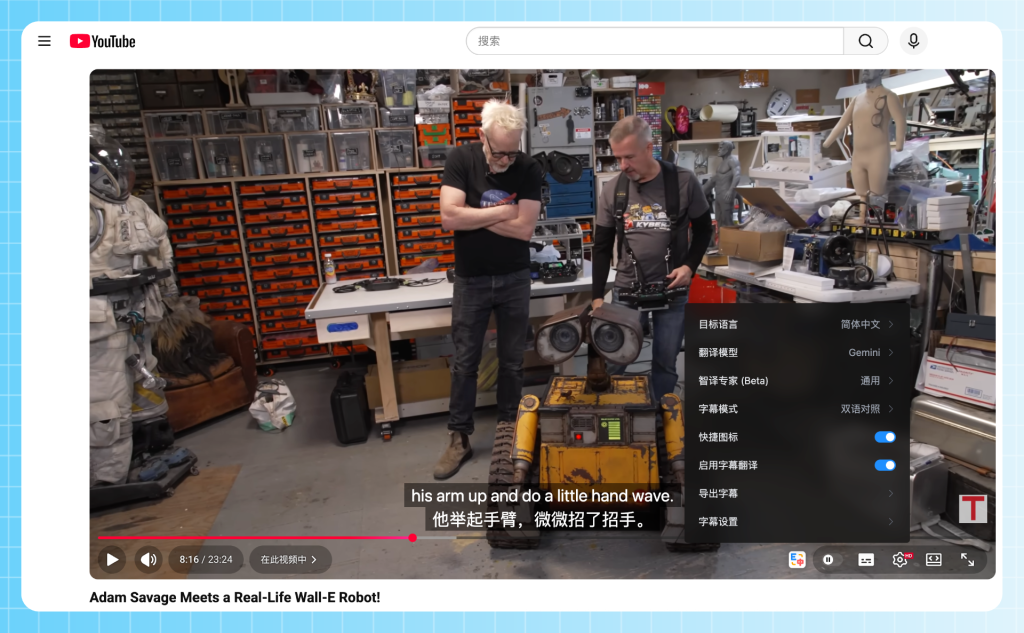
This architectural approach ensures that Video translation no longer depends on native platform capabilities but is instead managed uniformly at the browser level.
IV. Structural Re-engineering of the Foreign Video Translation Chain
From a systematic perspective, SelectTranslate deconstructs Foreign video translation into three distinct input types:
- Type A: Videos with CC Subtitles→ Enters the Subtitle translation workflow → Outputs bilingual Video subtitles.
- Type B: Videos Without Subtitles→ Enters the AI subtitle translation workflow → Outputs speech recognition + translated subtitles.
- Type C: Mixed Content Streams (Feed Videos)→ Automatically determines the subtitle source → Dynamically switches translation modes.
This creates a unified structure:
Video Content → Subtitle Recognition → Language Analysis → Translation Generation → Subtitle Rendering.
This framework covers all mainstream Video subtitle translation scenarios.
V. Key Value of SelectTranslate “AI Subtitle Translation”: Eliminating “Secondary Information Loss”
Traditional Information Chain:
Foreign Video → Third-party Translation → Secondary Retelling → User Comprehension.
- Issues: Information compression, semantic reconstruction, and decreased timeliness.
AI Subtitle Translation Chain:
Foreign Video → Real-time Speech Recognition → Subtitle Translation → Direct User Comprehension.
- Advantages: Zero intermediate retelling, preservation of original semantics, and ultra-low information latency.
In Video translation and Foreign video translation scenarios, the essence of AI subtitle translation is providing a direct line to the original information source.
VI. Keyword Coverage and Application Scenario Mapping
The system covers the following core demand terms:
- Video Translation: Overall language conversion of video content.
- Subtitle Translation: Language conversion based on existing subtitles.
- Video Subtitle Translation: Dual-layer processing of both video and subtitles.
- Foreign Video Translation: Cross-linguistic video comprehension.
- Translating Videos Without Subtitles: Generating subtitles via AI speech recognition.
- AI Subtitle Translation: A real-time speech-to-subtitle translation system.
Each keyword corresponds to an independent processing path rather than a single feature replacement.
VII. Conclusion: Video Translation is Shifting from “Subtitle Dependency” to “AI Generation”
Video content consumption is evolving from “watching” to “understanding.” This core shift is reflected in:
- Moving from Subtitle Dependency → AI Subtitle Translation dependency.
- Moving from Static Subtitle Translation → Real-time Video Subtitle Translation.
- Moving from Monolingual Viewing → Synchronized Multilingual Comprehension.
The essence of SelectTranslate‘s architecture is:
Using AI subtitle translation to bridge the final capability gap in Video subtitle translation, achieving unified coverage for all Foreign video translation scenarios. In the future of information consumption, the capability of Translating videos without subtitles will become a foundational visual requirement.