
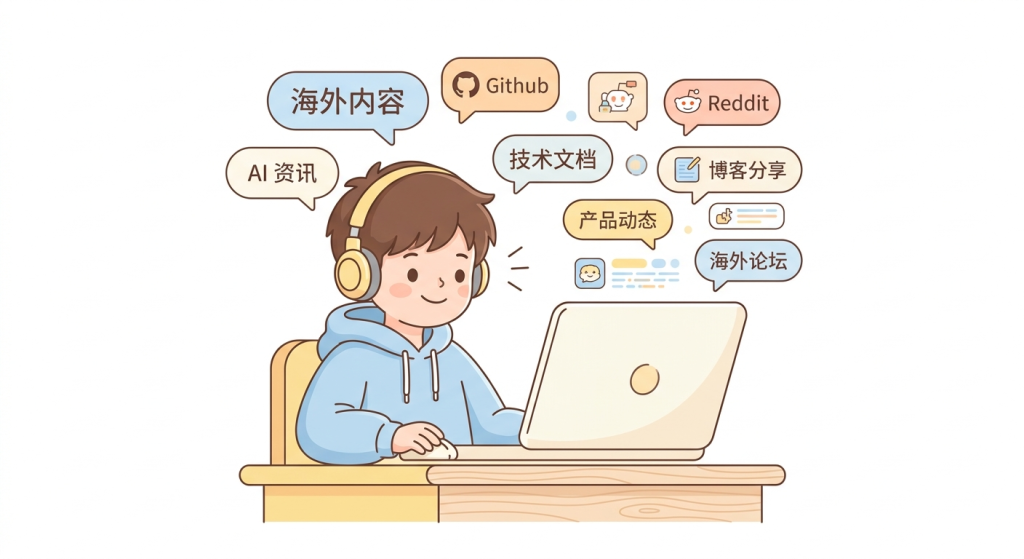
Have you run into these situations too? Your English isn’t very strong, but you still want to explore content from around the world. You know there’s more information available in the English-speaking world, yet you often click into a page only to leave moments later.
Why do so many people feel that their English isn’t good enough, but still want to browse overseas websites, tech communities, AI news, international forums, and product websites? The answer is simple: it’s not because English suddenly became more important — it’s because an increasing amount of valuable information appears in the English-speaking world first.
For example, the latest AI model capability analyses, overseas product launches, official technical documentation, real discussions among developers, in-depth content from international media, and experience sharing across Reddit, GitHub, and overseas blogs.
For many people, the real problem isn’t that they completely can’t understand English. The challenge is that consuming foreign-language content often feels exhausting, slow, and constantly interrupted.
This is also why more and more people are searching for:
“What is the best English webpage translator?”
“How can I read English websites effortlessly?”
“How can beginners browse overseas content with limited English skills?”
“Is there a webpage translation tool suitable for English beginners?”
Today, let’s talk about a problem many users face: if your English foundation is limited, how can you use the right tools to truly achieve a frictionless experience when browsing overseas content?
Why do English search results often feel more comprehensive than Chinese results?
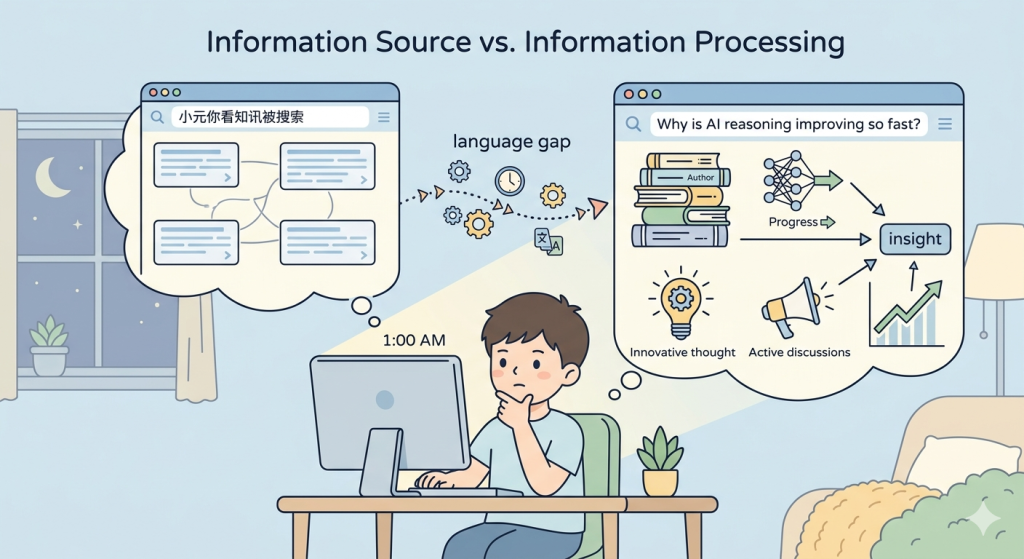
At 1 a.m., Xiaoyuan opened his computer. A question suddenly came to mind:
“Why are new AI models improving their reasoning capabilities so quickly?”
He searched and found many Chinese articles. But after reading for a while, something felt off. Some explanations seemed too superficial, some repeated the same information, and others were simply reposted or summarized from existing sources.
So he changed the way he searched:
“Why is AI reasoning improving so fast?”
The results looked completely different.
Suddenly, there were detailed international tech blogs, research discussions, developer analyses, and much more comprehensive explanations.
This isn’t just a feeling. There are real differences in how information is distributed across the internet. New technologies, product updates, and research discussions often emerge in the English-speaking world first, before gradually spreading into Chinese-language communities.
That’s why many people notice a pattern:
Chinese searches often show organized and repackaged information, while English searches frequently lead you directly to the original source of information.
But here’s the challenge: knowing that more information exists in English doesn’t automatically mean you can read it smoothly.
For most people, the biggest obstacle is usually not English proficiency itself — it’s the reading experience.
Why Are People with Limited English Skills More Likely to Give Up on Overseas Content?
Many people assume the problem is vocabulary size. In reality, a more common issue is that the reading process itself becomes frustrating.
After opening an English webpage, the workflow often looks like this:
① Copy the content
② Switch to a translation tool
③ Paste the text
④ Wait for the translation
⑤ Go back to the webpage and continue reading
Then repeat. Again. And again.
Content that should take five minutes to read can easily turn into a twenty-minute process.
Even more frustrating, traditional English webpage translation tools often create additional problems:
- Stiff and unnatural translations
- Sentences that sound awkward
- Inaccurate technical terminology
- Misunderstood context
- Broken webpage layouts
As a result, users end up doing this:
Read the original → Read the translation → Go back to the original → Question the translation → Double-check again
The entire reading flow gets interrupted repeatedly.
Eventually, a very common feeling starts to appear:
It’s not that the content is impossible to understand — it’s just too inconvenient.
Over time, the brain begins forming a habit of avoiding foreign-language content altogether. That’s one reason why many people know overseas content can be more valuable, yet gradually stop clicking on it.
How Does SelectTranslate Solve the Core Pain Points of English Webpage Translation?
Later, Xiaoyuan installed SelectTranslate for the first time.
He opened an English technical article and clicked the extension.
Then something changed.
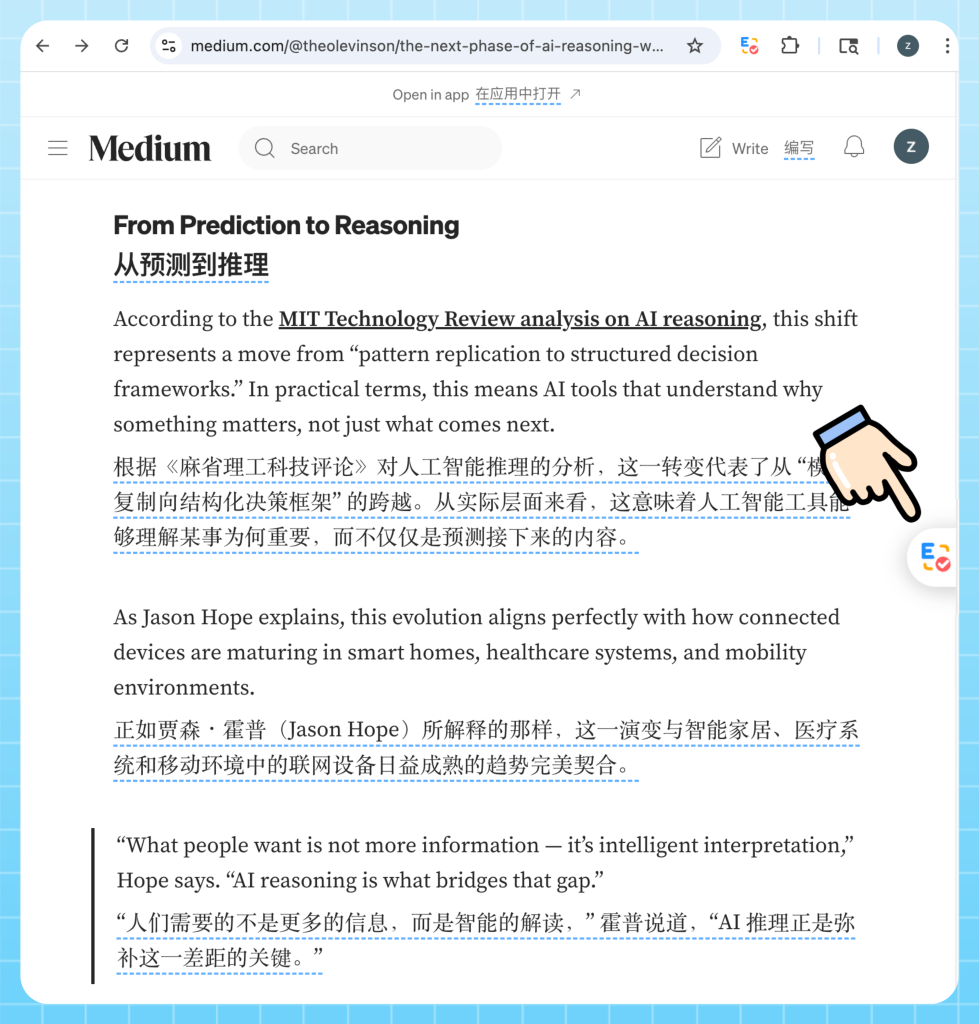
Directly below the original English text, the corresponding Chinese translation appeared instantly.
The reading process suddenly became:
Read the original → Read the translation → Continue scrolling
No need to:
❌ Copy content
❌ Switch between pages
❌ Jump back and forth
❌ Break your train of thought
For the first time, reading an English webpage felt as natural as reading a webpage in your native language.

Bilingual Webpage Translation
It directly addresses one of the biggest pain points of traditional English webpage translation: constant interruptions during reading.
Benefits: The original text and translated content are displayed side by side, eliminating the need to repeatedly switch between pages. Your reading flow stays uninterrupted, making it easier to understand and absorb information.
For people who frequently browse overseas websites, this difference becomes very noticeable. Translation is no longer a separate step — it becomes a seamless part of the reading experience itself.
Pain Point #2: Some People Just Want to Read Everything in Their Native Language
Some users simply want to get information quickly. They do not necessarily need line-by-line comparisons between the original and translated text.
SelectTranslate provides a Translation-Only Mode, which directly displays translated content across the entire webpage.
This is especially useful for:
- Quickly browsing news and updates
- Reading articles at scale
- Getting summaries of information
- Consuming large amounts of overseas content
For users with limited English skills, the experience feels almost like this:
Turning an English website directly into a native-language website.
Pain Point #3: Learning English and Reading at the Same Time Feels Difficult
Many people face a common dilemma:
They want to improve their English, but reading the original text directly feels too difficult.
SelectTranslate offers a Blur Mask (Learning Mode) to solve this problem.
While reading, you first try to understand the original content yourself. Then simply hover over the hidden area to reveal the actual translation.
This allows you to instantly verify:
- Whether your understanding was correct
- Which words were misunderstood
- Which sentence structures you have not fully mastered
Compared with simply memorizing vocabulary lists, this approach feels much closer to real-world language learning.
Many users discover that they improve not only their reading speed, but also their overall English comprehension.
Pain Point #4: Sometimes You Only Need to Translate Specific Sections
As English skills improve, many users realize that they can already understand most of the content. Only a few sentences or paragraphs occasionally become difficult.
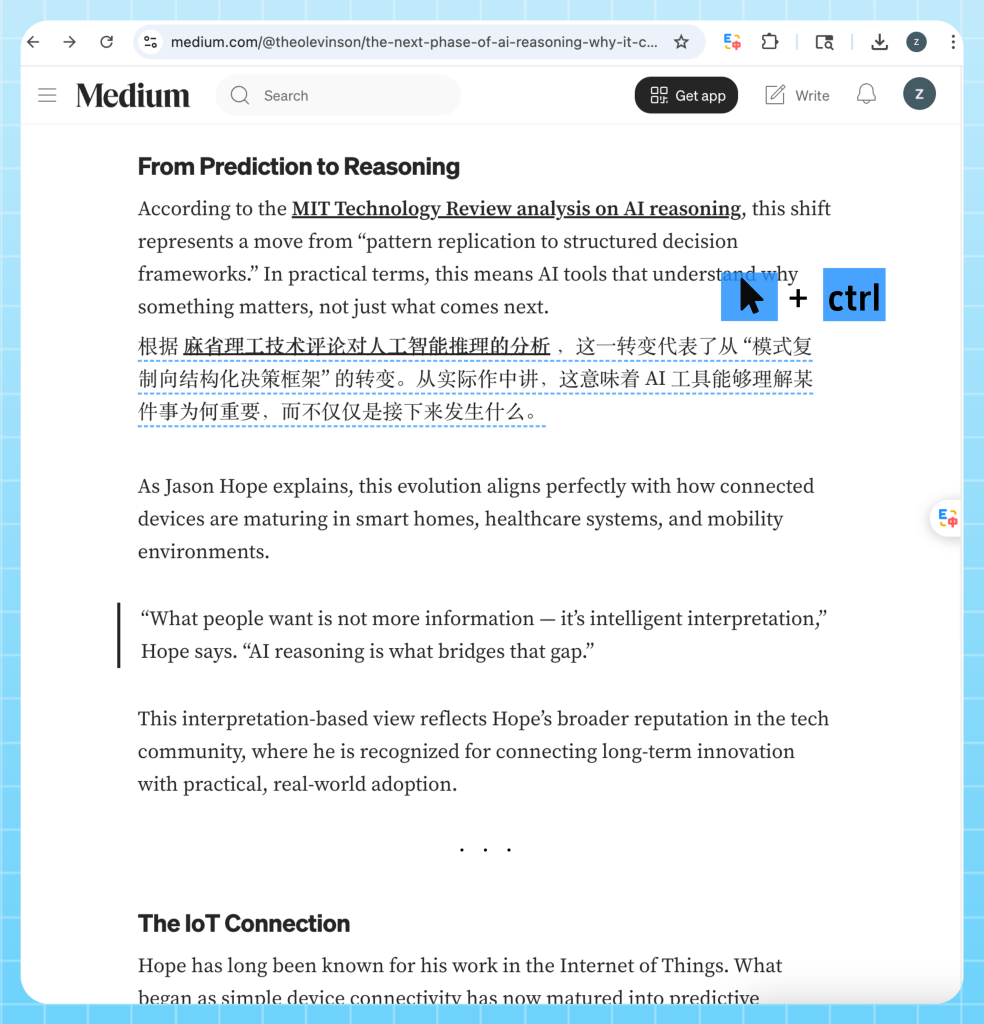
This is where SelectTranslate’s Hover Translation feature becomes useful.
Default trigger: Hover your mouse while pressing Ctrl (⌃) to translate or restore the original content.
Translate only when needed, and keep the original text untouched when it is not.
This avoids the distractions often caused by translating an entire webpage.
This type of on-demand translation is especially useful for:
English blogs
Technical documentation
Overseas forums
Developer communities
AI research materials
Why Is SelectTranslate More Than Just an English Webpage Translation Tool?
Many people start using SelectTranslate simply for translation.
But later, they realize that something bigger has changed.
Before:
“This English article is too long. Forget it, I’ll skip it.”
Now:
“Let me open it and take a look first.”
It may seem like a small change, but behind it is something much larger:
the ability to access information.
Because much of the world’s newest information is often:
- More in-depth
- More complete
- More cutting-edge
- Closer to the original source
Once reading barriers become lower, people naturally begin expanding the range of information they consume.
SelectTranslate does not create more information on the internet.
What it actually does is reduce the barriers to accessing knowledge.
Frequently Asked Questions (FAQ)
Can people with limited English skills use an English webpage translation tool?
Yes.
Many users are not completely unable to understand English; the issue is often that the reading process becomes too complicated.
A bilingual English webpage translation tool like SelectTranslate can significantly reduce the effort required to read and understand overseas content.
What situations is SelectTranslate suitable for?
Common use cases include:
- Reading AI news and updates
- Technical documentation
- GitHub content
- International media websites
- English blogs
- Official product websites
- Overseas forums
How is SelectTranslate different from traditional translation tools?
Traditional translation tools mainly solve a single problem:
translation itself.
SelectTranslate focuses more on another question:
How can reading remain uninterrupted?
For example:
- Bilingual webpage translation
- Translation-only mode
- Blur Mask learning mode
- Hover translation
Conclusion: How Can People with Limited English Skills Truly Browse Overseas Content Effortlessly?
The answer may not be memorizing thousands of vocabulary words first.
It may be reducing the barriers to reading.
When reading no longer requires:
Copy → Paste → Switch → Return
and when webpage translation becomes a seamless part of the reading experience itself, overseas content stops feeling like a barrier.
More and more people choose SelectTranslate not simply because it is a translation tool, but because it helps them stop avoiding foreign-language content.
When you can smoothly access more information from around the world, the world you see naturally becomes larger.