
Have you ever run into situations like these? You open YouTube to learn an AI tutorial, but within ten minutes you’re already pausing repeatedly to look up unfamiliar words. You find a high-quality overseas course on Coursera, but the instructor speaks too quickly and uses too many technical terms. Or while watching TED talks, international tech presentations, or programming tutorials, you constantly feel like you “kind of understood it,” but in reality very little information truly stays with you.
Many people assume the problem is their English level, but a more common issue is this: the learning process keeps getting interrupted by translation.
Overseas platforms are increasingly becoming the first place where new knowledge appears. Whether it’s AI model updates, programming tutorials, industry trend analysis, business courses, or cutting-edge technology discussions, a large amount of high-value content often appears first on platforms like YouTube, Coursera, Udemy, and TED.
But the traditional viewing process usually looks something like this:
Watch one sentence → Pause → Look up words → Switch to a translation tool → Return to the video → Pause again.
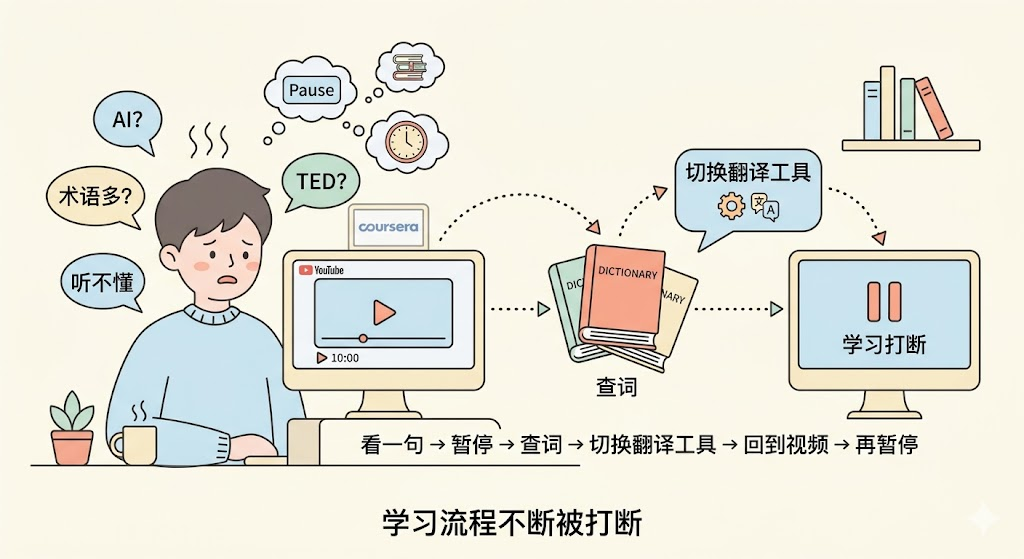
After a few rounds of this process, the thing consuming your time is no longer learning itself — it’s repeated translation. What SelectTranslate’s bilingual video subtitle translation really solves is not simply the speed of translation, but the interruptions that break the learning process. It turns reading, watching, and understanding into a continuous experience.
Why Are More People Searching for YouTube Video Translation Tools?
People searching for “YouTube video translation” are usually not just trying to convert English into Chinese. More often, they are trying to solve practical problems such as:
- How can I understand overseas AI tutorial videos?
- How can I watch YouTube videos without Chinese subtitles?
- How can I learn from overseas courses more efficiently?
- How can I reduce the language barrier of English courses?
- How can I understand programming tutorial videos?
- How can I learn English while learning professional content?
In reality, when content involves fields such as AI, programming, business, and technology, ordinary translation tools are often not enough.
Because for many types of content, the issue is not:
“It can’t be translated.”
The real issue is:
“Even after translation, it’s still difficult to understand.”
How to Use Bilingual Video Subtitle Translation for Learning AI and Technical Courses
Supported platforms: YouTube, Coursera, Udemy, Frontend Masters, Khan Academy, Edx
Learning AI is probably one of the areas where language barriers appear most often.
For example, you might search YouTube for:
- Build AI Agent Tutorial
- RAG Full Course
- Prompt Engineering Tutorial
- Open Source LLM Guide
Once you open the video, you may quickly run into terms like:
Fine-tuning, Retrieval, Inference, Embedding, Tokenization, Latency
Even if these terms are translated, they are not always easy to understand.
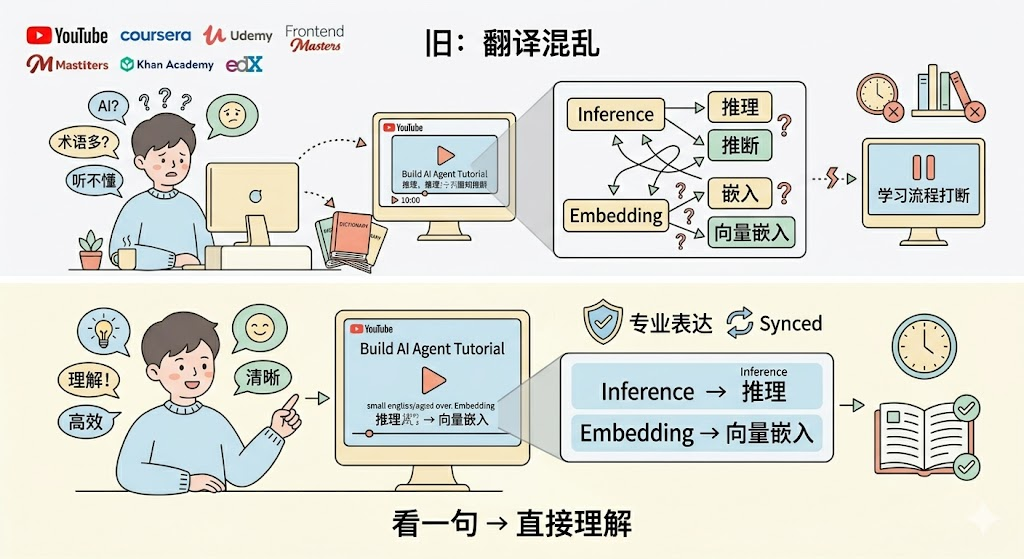
A more common issue is inconsistency: the same term may be translated differently by different tools. For example, within a single video, “Inference” might first be translated as one meaning and later as another. “Embedding” could also appear with multiple translated variations.
The result is that learners repeatedly have to rebuild context throughout the learning process.
With SelectTranslate’s bilingual video subtitle translation, the original subtitles and translated subtitles appear together in sync. This preserves the original technical terminology while allowing you to understand the meaning immediately.
Before:
Watch one sentence → Search once
Now:
Watch one sentence → Understand directly
For long-term AI learning, the difference in experience becomes very noticeable.
How to Use YouTube Video Translation for Learning Programming and Development Courses
Supported platforms: YouTube, Frontend Masters, Udemy, CodeWithChris
Many developers have experienced the same situation: you understand the code itself, but when the instructor starts explaining the logic behind it, things suddenly become difficult to follow.
For example, the instructor might say:
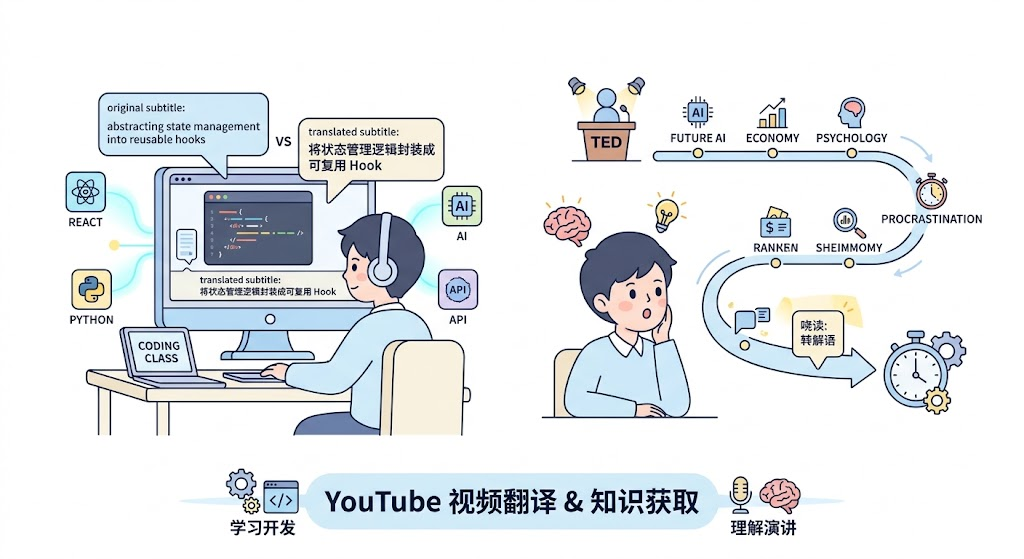
We are abstracting the state management logic into reusable hooks.
A traditional translation tool may directly output something like:
We are abstracting the state management logic into reusable hooks.
Technically, the translation may not be wrong, but developers often still need a second round of interpretation before the meaning becomes truly clear.
In a bilingual video subtitle translation scenario, however, the original content and translated text appear together in sync. This makes it much easier for developers to establish complete context and understand the intended meaning:
Encapsulating state management logic into reusable Hooks.
Instead of translating individual words literally, the focus shifts toward understanding the concept itself.
This difference becomes especially noticeable when learning topics such as:
- React tutorials
- Python development
- AI engineering
- API development
- Cloud computing
- Front-end engineering workflows
For technical content, maintaining context often matters more than direct word-for-word translation.
How Can You Better Understand TED Talks, Educational Presentations, and Overseas Knowledge Videos?
Supported platforms: TED, Nebula, BBC, Vimeo, Dailymotion
Many high-quality learning resources do not necessarily come from structured course platforms. A huge amount of valuable content now comes from international knowledge communities and educational creators.
For example:
- How will AI evolve in the future?
- Why do humans procrastinate?
- Global economic trend analysis
- Research in psychology and cognitive science
The biggest challenge with these videos is often not vocabulary — it is information density.
TED talks are especially like this.
A speaker may deliver multiple ideas within a single minute while simultaneously using:
- Long sentence structures
- Metaphors
- Conversational expressions
- Fast speaking speed
With traditional viewing methods, a common situation happens:
You are still translating the previous sentence in your head while the next one has already passed.
SelectTranslate’s bilingual video subtitle translation creates a smoother information flow.
Instead of constantly performing instant mental translation, your brain can focus on what actually matters:
understanding and absorbing the content itself.
How Can You Understand Videos Without Subtitles?
Another major reason many users search for YouTube video translation tools is surprisingly simple: the video has no subtitles at all.
This situation is especially common with:
- Overseas livestream replays
- Niche technology channels
- AI sharing sessions
- Newly uploaded videos
- Industry conference recordings
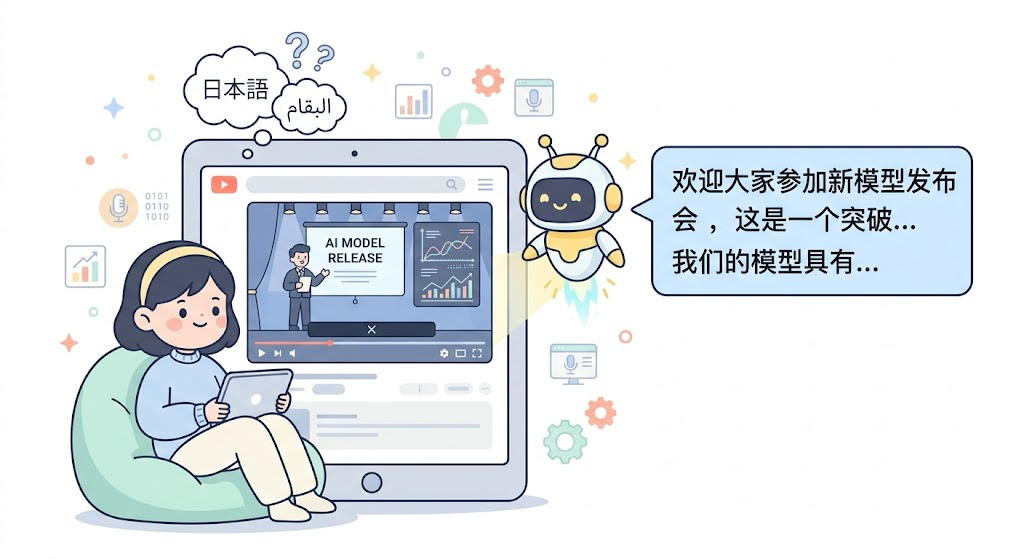
In these cases, most translation tools simply stop working because they rely on existing subtitles.
SelectTranslate supports AI-powered real-time subtitle translation, which means that even if a video originally has no subtitles, it can automatically recognize speech and generate translated subtitles instantly.
This changes content that was previously difficult or impossible to watch into something that becomes immediately understandable.
For example, you no longer need to wait for manually created subtitles when watching:
- Newly released AI model introduction videos
- Recordings from overseas tech conferences
- Developer presentations and technical discussions
Instead of waiting for subtitles to appear days or weeks later, you can start understanding the content as soon as it becomes available.
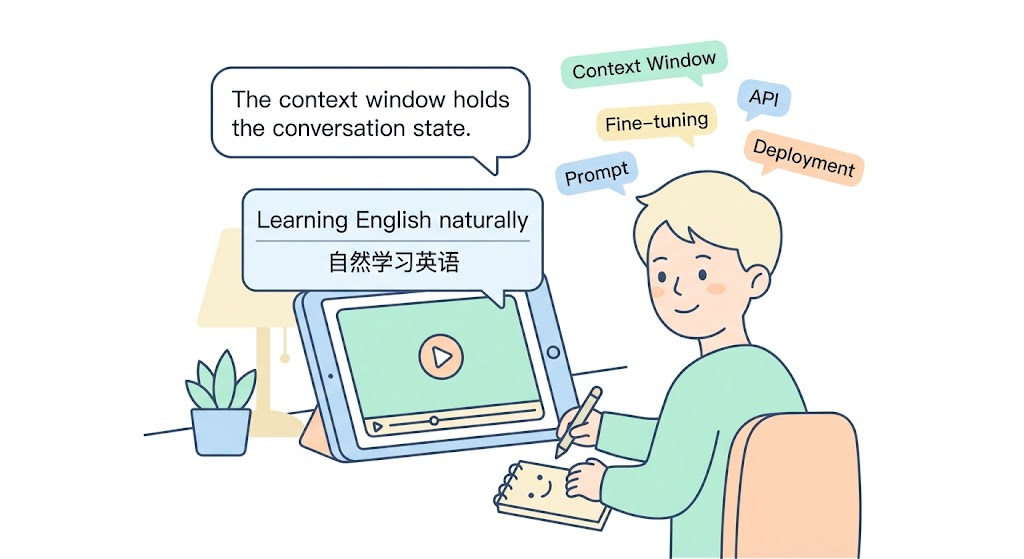
How Can You Learn English While Watching Videos?
Many users who search for YouTube video translation tools have another goal beyond simply understanding content: they do not want to rely entirely on translations — they want to gradually improve their English skills as well.
Reading only translated text can easily create dependence. In contrast, a bilingual subtitle mode follows a learning process that feels much closer to how language is naturally acquired:
Read the English → Understand it with the help of the translation → Build semantic connections → Gradually reduce reliance on translation
Over time, many frequently used terms start becoming familiar naturally, such as:
- Prompt
- Context Window
- Fine-tuning
- API
- Deployment
Instead of memorizing isolated vocabulary lists, this method creates language associations through real-world contexts and practical usage scenarios.
For many learners, this approach often leads to stronger long-term retention because words are learned as part of meaningful content rather than as standalone definitions.
Which Video Platforms Does SelectTranslate Support?
Currently, SelectTranslate’s bilingual video subtitle translation supports a wide range of mainstream video platforms, covering learning, entertainment, streaming, and communication scenarios.
Knowledge & Learning Platforms:
YouTube, Coursera, Udemy, TED, Khan Academy, Frontend Masters, EdX
Streaming Platforms:
Netflix, Disney+, Prime Video, Hulu, Apple TV, HBO, Crunchyroll
Video Content Platforms:
Bilibili, X (Twitter), Vimeo, BBC, Dailymotion
Online Meeting Platforms:
Zoom, Google Meet, Microsoft Teams
How to Enable SelectTranslate Video Subtitle Translation
The setup process is very simple:
Open a supported video platform page, launch the SelectTranslate extension panel, and enable [Video Subtitle Translation].
You can also adjust subtitle display and translation modes using the SelectTranslate icon below the video.
If subtitles or translation do not appear immediately after opening the video, simply refresh the page.
Final Insight
What most often limits overseas content learning is not English ability itself, but interruptions in the understanding process.
SelectTranslate’s bilingual video subtitle translation and YouTube video translation capability help integrate translation directly into the learning flow, rather than treating it as an extra step.
When translation no longer disrupts the viewing experience, a large amount of content on platforms like YouTube, Coursera, Udemy, and TED can finally become knowledge that can be absorbed smoothly and continuously.