
For many Steam players in the U.S., the thing that kills excitement isn’t game difficulty, and it isn’t even surviving another Steam sale.
It’s this:
You finally discover a game that perfectly matches your taste, click into the page, and then immediately see:
“This game does not support English.”
That moment ends the experience for a lot of people.
And lately, this happens more often than many players expect.
Japanese indie games, visual novels, niche RPGs, early access titles, fan projects, community mods, developer blogs, and workshop content frequently appear in Japanese first. Some eventually get English localization months later.
Many never do.
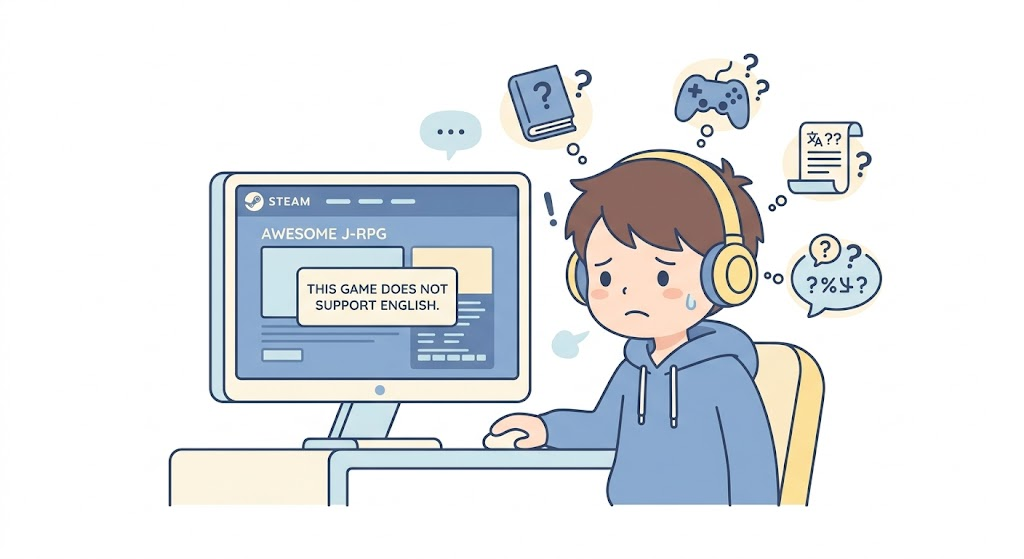
As a result, Steam users constantly run into situations like these:
- You want to read a game’s story description but can’t understand it.
- You want to check gameplay systems but aren’t sure what features it actually has.
- You open update notes and have no idea what changed.
- You scroll through community discussions and feel like everyone else understands an inside joke you missed.
- You want to leave feedback or talk to Japanese players and developers, but language becomes a wall.
The bigger problem:
This doesn’t happen once.
It happens during the entire Steam experience.
Why Japanese Content on Steam Feels More Frustrating Than People Expect
Many players assume:
“My Japanese just isn’t good enough.”
But vocabulary usually isn’t the main issue.
The real problem is interruption.
Information keeps getting broken apart.
Here’s a realistic example:
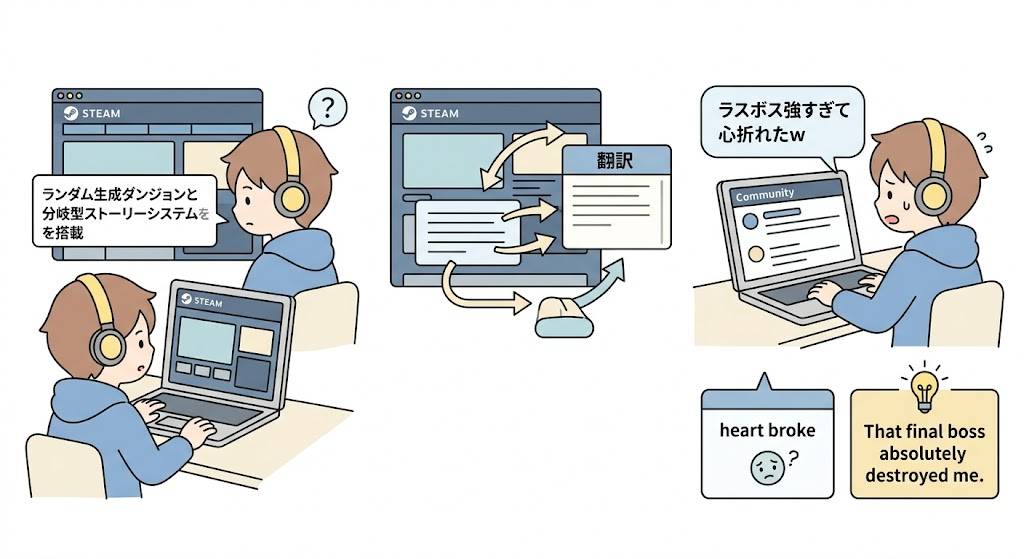
You discover a highly rated Japanese indie RPG and open the Steam page.
You see:
“ランダム生成ダンジョンと分岐型ストーリーシステムを搭載”
You don’t know what it means.
So you:
Copy text → open translator → paste → translate → return to Steam.
After several seconds, you’ve already forgotten where you were reading.
Then you move into community comments:
“ラスボス強すぎて心折れたw”
Literal translation tools might output:
“The final boss was so strong that my heart broke.”
Technically correct.
But that’s not what players actually mean.
The real meaning is closer to:
“That final boss absolutely destroyed me.”
Gaming language, internet humor, Japanese slang, and community memes don’t behave like textbook language.
And Steam is heavily community-driven.
Why Traditional Translation Tools Often Feel Incomplete for Steam
Basic translation tools are already very good at translating isolated text.
The problem starts when they’re used inside the Steam ecosystem.
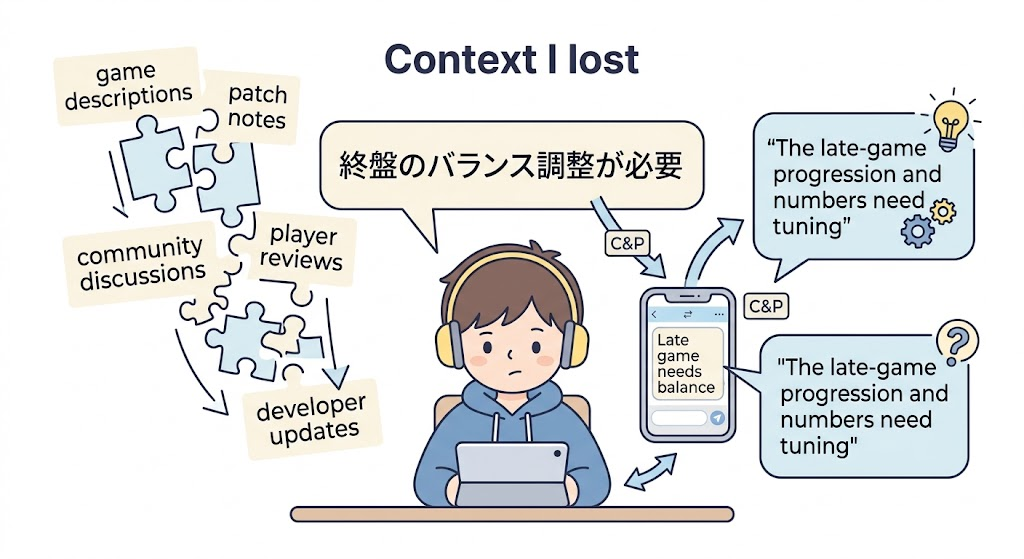
1. Context Gets Lost
Many translation workflows still rely on copy-and-paste behavior.
Steam content isn’t isolated sentences.
It’s continuous content:
- game descriptions
- patch notes
- community discussions
- player reviews
- developer updates
Breaking content into small pieces removes context.
For example:
“終盤のバランス調整が必要”
Literal translation:
“Late game needs balance.”
What players actually mean:
“The late-game progression and numbers need tuning.”
Context changes meaning.
2. Gaming Language Doesn’t Translate Literally
Steam communities constantly use gaming terminology and internet culture:
- Gacha
- DPS
- Meta
- Nerf
- Buff
- AFK
- RNG
- Farming
- Grinding
- GG
Japanese communities also frequently use expressions like:
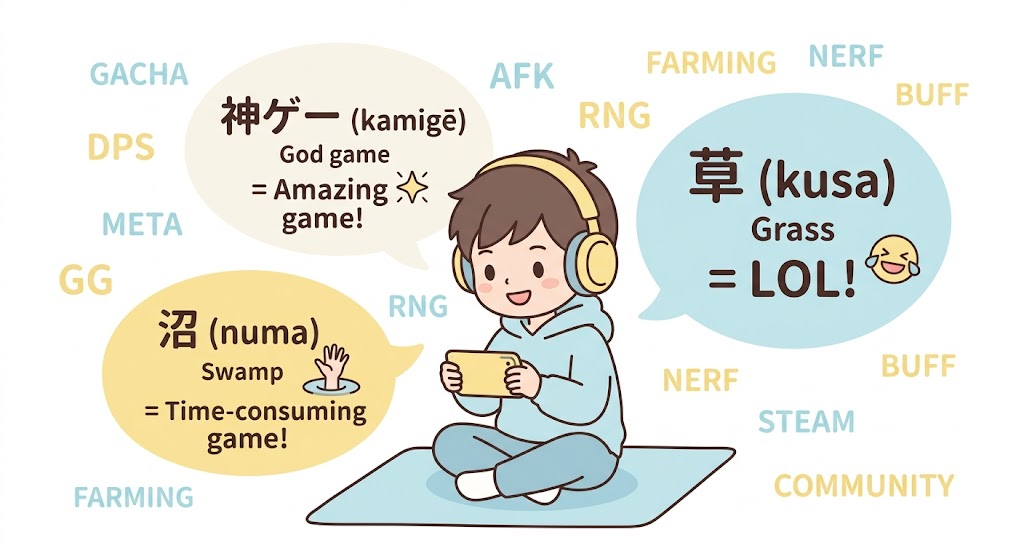
- 草
- 神ゲー
- クソゲー
- 沼
- 人権
Literal translation can create strange results:
草 → Grass
Actual meaning:
“LOL”
神ゲー → God game
Actual meaning:
“Amazing game”
沼 → Swamp
Actual meaning:
“A game that’s consuming all your time and energy.”
Without player context, translations become awkward very quickly.
3. Constant Switching Creates Friction
Research from usability studies, including work by user experience experts, consistently shows that frequent task switching increases cognitive load and interrupts understanding.
Steam’s biggest problem isn’t translating once.
It’s translating repeatedly.
You translate:
- game descriptions
- player reviews
- patch notes
- community posts
- workshop pages
- developer updates
Again and again.
Eventually the experience feels fragmented.
How Can Steam Players Get a Near-Localized Experience for Japanese Games?
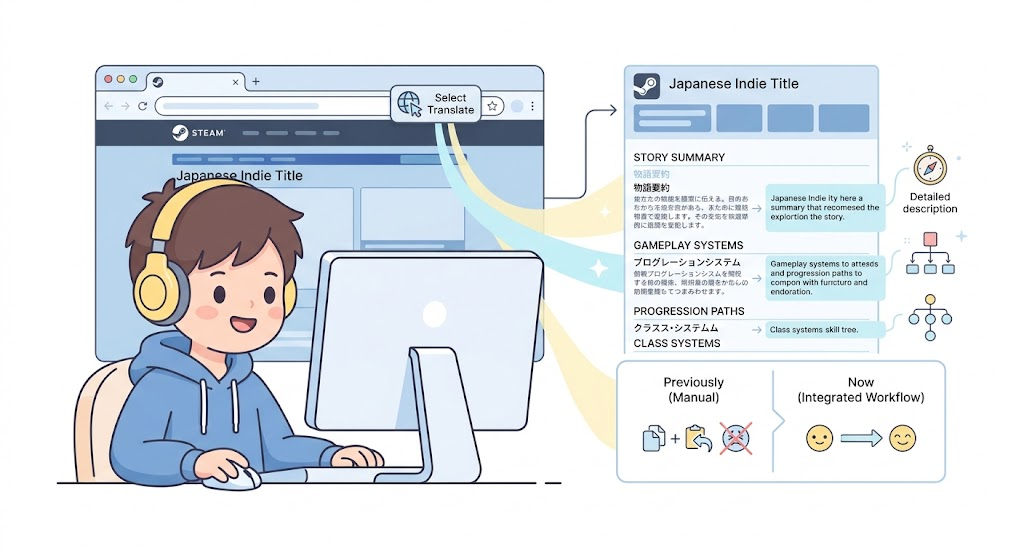
SelectTranslate now supports the Steam client experience in a way that feels closer to installing a localization layer directly into Steam.
The difference isn’t simply translation.
It’s integrating translation into the workflow itself.
Translate Game Pages Before You Buy
Most players look at:
- story summaries
- gameplay systems
- combat mechanics
- requirements
- development roadmaps
- version differences
Previously:
Copy → Translate → Return.
Now:
Open the page and read translated content directly.
This becomes especially useful for Japanese indie titles, which often contain extremely detailed descriptions covering:
- worldbuilding
- class systems
- progression paths
- combat design
- exploration mechanics
Instead of spending ten minutes translating sections manually, you can simply browse.
Real-Time Review Translation Makes Community Content Understandable
Steam reviews are often where the real entertainment happens.
Some players write serious analysis.
Others create memes.
Others somehow write entire comedy essays.
Example:
“Bought for $5. Played 400 hours. Do not recommend.”
Literal translation seems confusing.
But experienced players understand the joke immediately:
“I played this game obsessively and still jokingly say I don’t recommend it.”
With real-time review translation, humor, sarcasm, and community culture become easier to understand.
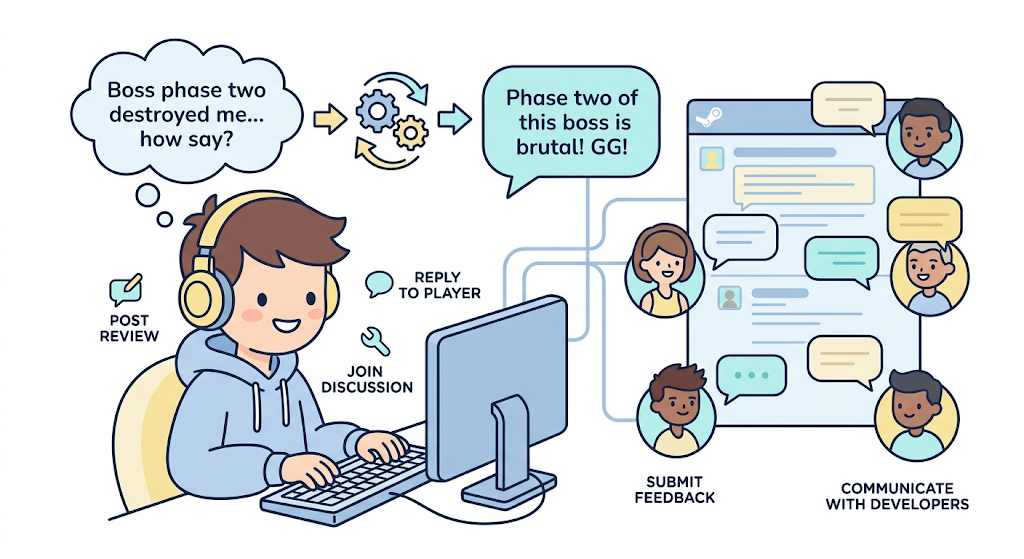
Input Translation Makes Interaction Easier
Many people don’t avoid posting because they have no opinions.
They avoid posting because they don’t know how to phrase them.
You want to write:
“Phase two of this boss absolutely destroyed me.”
But you worry about awkward wording.
Input translation can optimize phrasing while keeping the original meaning.
Instead of sounding unnatural, your message becomes more aligned with how players actually communicate.
Now you can:
- write reviews
- join discussions
- reply to players
- submit feedback
- communicate with developers
Steam stops being something you only read.
It becomes something you participate in.
Current Steam Translation Limitations
There are still a few limitations:
1. Steam video subtitles
Because of player-side restrictions, AI subtitle translation for embedded Steam videos may not be available.
2. In-game text is separate
Translation applies to Steam content and browsing experiences rather than text inside the running game itself.
However, for many players, the majority of time isn’t spent after launching the game.
It’s spent on:
- discovering games
- reading community content
- checking updates
- browsing workshop pages
- interacting with players
And these are exactly the places where language barriers appear most often.
Why More Steam Players Are Looking for Japanese Translation Solutions
Steam is no longer just a game launcher.
It’s increasingly becoming a global gaming community.
You’re not only reading game pages.
You’re consuming:
- developer updates
- community discussions
- player guides
- workshop content
- memes
- player culture
- real-time feedback
Language barriers don’t remove this content.
They only make people miss it.
The real value of translation isn’t simply turning Japanese into English.
It’s keeping reading uninterrupted.
Keeping interaction uninterrupted.
Keeping the experience uninterrupted.
Once translation becomes part of the process itself, Steam starts feeling much closer to a complete localized experience.