
Learning a new language has never been more important. More Americans and Europeans are now trying to learn Arabic for international business, global news, religion, travel, and Middle Eastern culture, while Spanish continues to be one of the most practical and widely used languages in the United States, especially for communication, work opportunities, entertainment, and daily life.
But there is a huge difference between “studying a language” and actually being able to understand real-world content.
Many learners quickly discover the same frustrating reality: memorizing vocabulary lists and grammar rules does not automatically help you understand native articles, videos, conversations, social media posts, or websites.
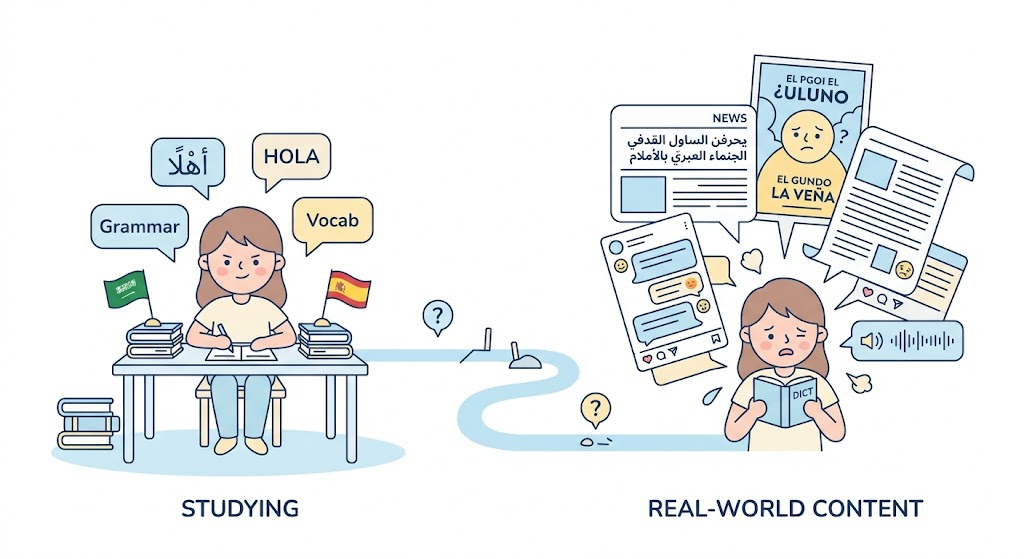
This is where most language learners begin to struggle.
Why Learning Arabic Is So Difficult for English Speakers
Arabic is considered one of the hardest languages for native English speakers to learn, and for good reason.
The challenge is not only vocabulary. Arabic introduces multiple layers of difficulty at the same time:
- A completely different writing system
- Right-to-left reading
- Context-dependent word forms
- Complex grammar structures
- Regional dialect variations
- Formal Arabic vs spoken Arabic
- Words whose meanings change heavily depending on context
For many beginners, reading Arabic online feels overwhelming.
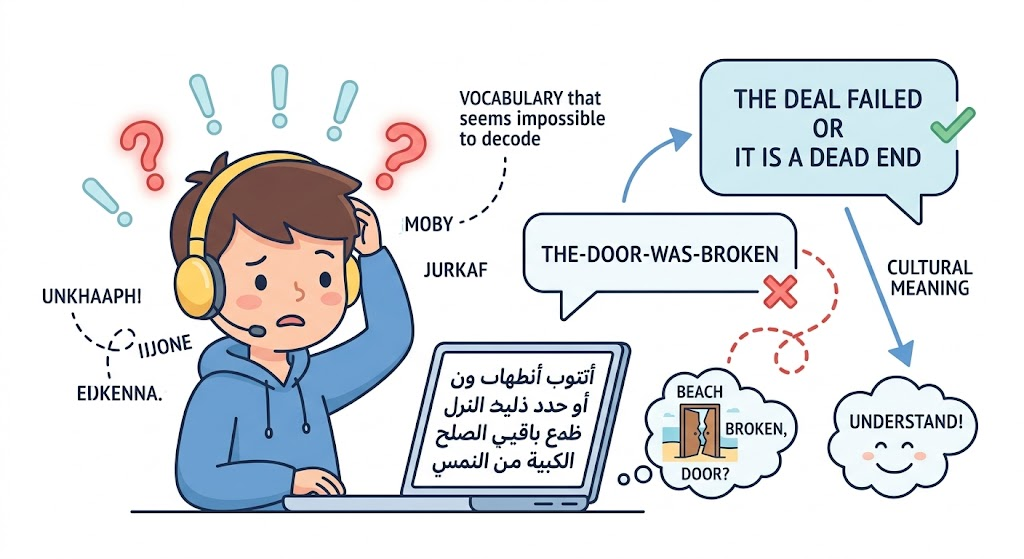
A learner may open an Arabic news article or social media post and immediately encounter unfamiliar script, unknown sentence structures, and vocabulary that seems impossible to decode word by word.
Even if you use a traditional translator, the result is often confusing because literal translations fail to explain the actual meaning behind the sentence.
For example, many Arabic expressions are highly contextual and culturally dependent. A direct word-for-word translation may technically be “correct,” while still sounding unnatural or completely misleading in English.
This creates one of the biggest pain points in Arabic learning:
You may translate every individual word and still fail to understand what the sentence actually means.
Why Learning Spanish (Especially Mexican Spanish) Is Harder Than People Expect
Many English speakers assume Spanish is “easy” because it shares the Latin alphabet and contains familiar vocabulary.
But once learners move beyond beginner apps and textbook phrases, real-world Spanish becomes much more difficult.
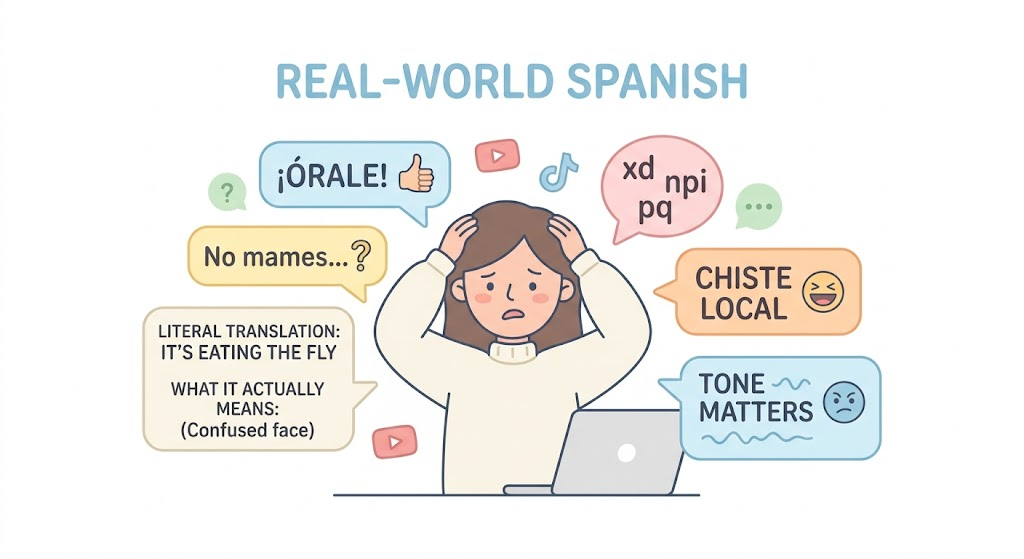
Especially when learning Mexican Spanish through YouTube videos, TikTok content, movies, online communities, or conversations with native speakers, learners encounter:
- Fast natural speech
- Slang and regional expressions
- Context-heavy phrases
- Idioms that cannot be translated literally
- Informal abbreviations
- Culture-specific meanings
For example, a single Spanish phrase may mean something completely different depending on tone, region, or situation.
Traditional translation tools often fail here because they treat language like isolated text instead of living communication.
A learner trying to read Mexican social media posts or comments may repeatedly run into problems like:
- Literal translations that sound robotic
- Incorrect slang interpretation
- Missing emotional tone
- Confusing sentence structures
- Inability to understand contextual humor
This is why many learners plateau.
They can pass vocabulary quizzes, but they still cannot comfortably consume real native content.
The Biggest Problem With Traditional Translation Tools
Most traditional translation tools were designed for simple text conversion — not for real language acquisition.
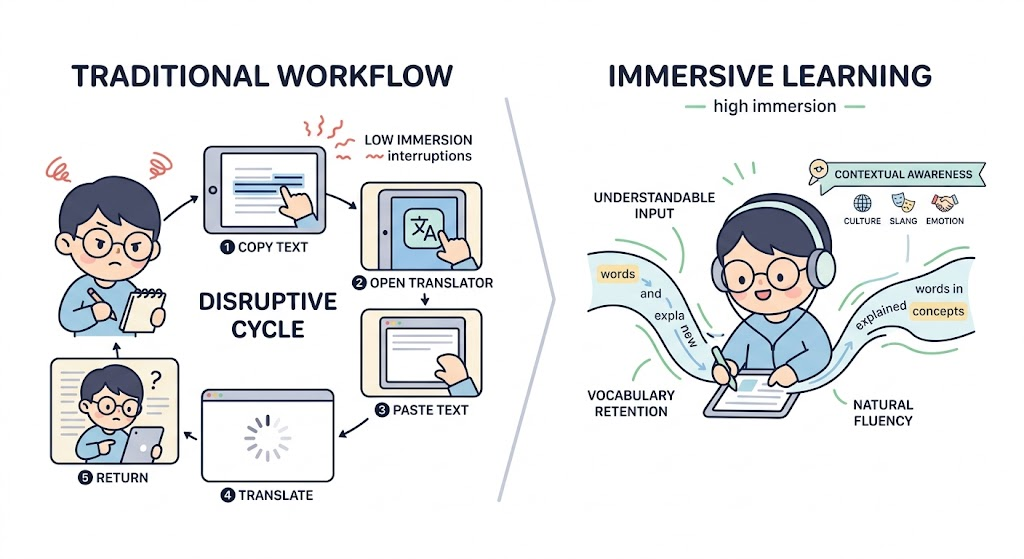
Their workflow is usually slow and disruptive:
- Copy text
- Open translator
- Paste text
- Translate
- Return to original content
- Repeat again and again
This constant interruption destroys immersion.
And immersion is critical for language learning.
Research in language acquisition consistently shows that continuous exposure to understandable input helps learners develop comprehension, vocabulary retention, pronunciation familiarity, and natural language intuition.
But traditional translators interrupt this process constantly.
Even worse, many tools do not truly understand context.
They often translate words individually instead of analyzing:
- The surrounding paragraph
- Topic context
- Cultural usage
- Slang
- Industry terminology
- Emotional tone
- Conversational intent
As a result, learners frequently receive technically correct but practically useless translations.
How SelectTranslate Solves These Problems Better Than Traditional Translators
This is where SelectTranslate becomes fundamentally different.
Instead of acting like a detached translation website, SelectTranslate works directly inside your browsing experience.
Its inline selection translation feature turns language learning into a smooth, uninterrupted process.
When reading Arabic articles, Mexican Spanish posts, international forums, YouTube subtitles, news websites, or educational content, users can simply highlight a word or sentence and instantly receive an intelligent contextual translation without leaving the page.
No copying.
No tab switching.
No breaking concentration.
This matters far more than many learners realize.
Because the easier it becomes to stay inside native content, the more consistent your language exposure becomes.
And consistent exposure is what builds real fluency.
Context-Aware AI Translation: Why It Matters for Language Learning
One of SelectTranslate’s biggest advantages is its AI-powered contextual understanding.
Instead of translating words mechanically, the system first analyzes the sentence, nearby content, topic, and intended meaning before generating translations.
This is especially valuable for Arabic and Mexican Spanish because both languages rely heavily on context.
For example:
- Arabic words often change meaning depending on grammar and surrounding structure.
- Mexican Spanish slang may completely differ from textbook Spanish.
- Informal phrases may carry emotional or cultural implications that literal translation misses.
Traditional translators often fail to explain these nuances.
SelectTranslate helps learners understand not just “what the word means,” but what the speaker actually intends to say.
This dramatically improves:
- Reading comprehension
- Vocabulary retention
- Context recognition
- Natural phrase understanding
- Real-world language intuition
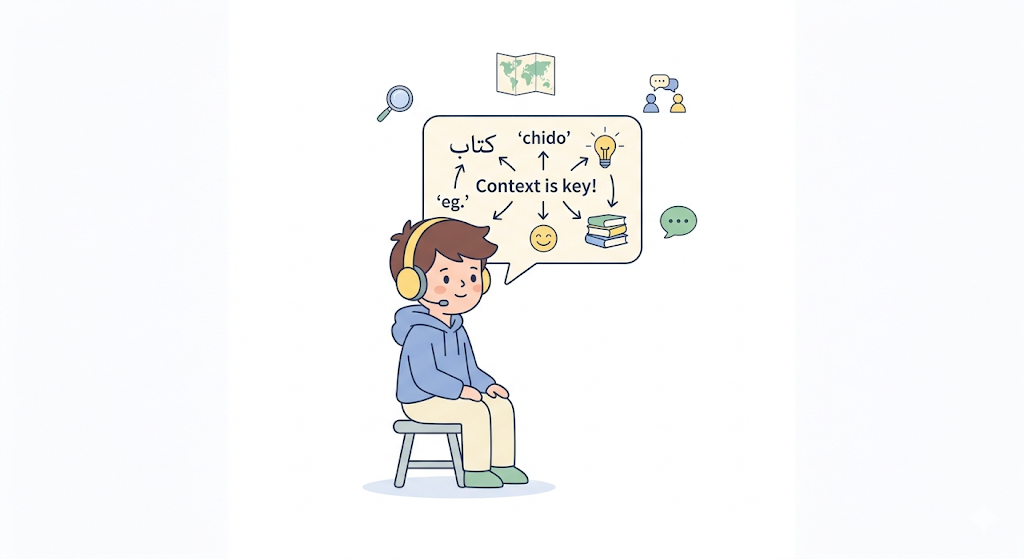
Learning Vocabulary Through Real Context Instead of Memorization
Many language learners waste enormous amounts of time memorizing isolated vocabulary lists.
But real fluency rarely comes from memorization alone.
The human brain learns languages more effectively when vocabulary appears inside meaningful situations.
That is exactly where SelectTranslate becomes powerful.
When selecting a single word, the system can intelligently provide:
- Pronunciation
- Word type
- Contextual meaning
- Bilingual examples
- AI-based explanation
- Natural usage interpretation
This transforms simple translation into active language learning.
Instead of learning disconnected dictionary definitions, users begin understanding how native speakers actually use the language.
For Arabic learners, this helps decode difficult sentence structures and contextual vocabulary.
For Spanish learners, it helps interpret slang, conversational tone, and real-world expressions more naturally.
Why SelectTranslate Improves Language Learning Efficiency
Most learners do not quit because languages are impossible.
They quit because the process feels exhausting.
When every unknown word requires multiple interruptions, learning stops feeling immersive and starts feeling like work.
SelectTranslate removes much of this friction.
By integrating AI translation directly into browsing and reading, it allows users to:
- Stay focused longer
- Read more native content
- Learn vocabulary naturally
- Maintain immersion
- Build language intuition faster
- Practice pronunciation while reading
- Understand difficult sentences instantly
This is especially valuable for people learning through real content instead of textbooks.
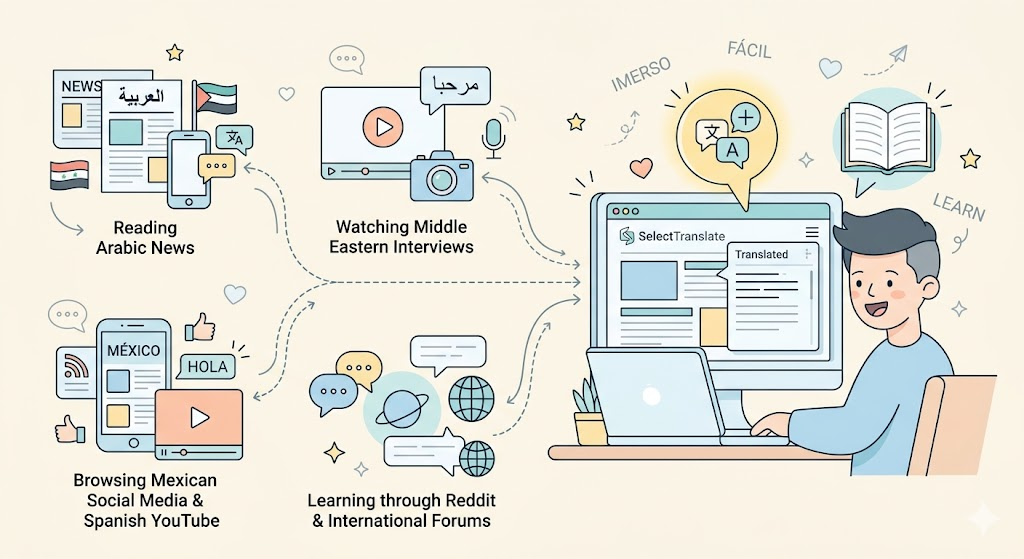
Whether someone is:
- Reading Arabic news
- Watching Middle Eastern interviews
- Browsing Mexican social media
- Studying Spanish YouTube videos
- Learning through Reddit communities
- Exploring international forums
- Reading foreign blogs and websites
SelectTranslate helps transform passive browsing into active language acquisition.
Why More Learners Are Treating SelectTranslate as an Essential Language Learning Tool
The future of language learning is no longer based purely on memorization.
It is increasingly based on intelligent assistance, contextual understanding, and immersive input.
Compared to traditional translation tools, SelectTranslate is designed around how modern people actually learn languages online.
It reduces friction, improves contextual understanding, preserves reading flow, and makes native content significantly more accessible.
For learners trying to figure out how to efficiently learn Arabic or Spanish in real-world environments, this creates a major advantage.
Instead of constantly leaving the content to translate it, learners can stay inside the language itself — which is ultimately where real learning happens.