
The hardest part of judging AI translation today is that mistakes no longer always look like mistakes. Older machine translations often gave themselves away through awkward wording, unnatural sentence structure, or obvious vocabulary errors. Modern AI translation is different: a sentence can sound completely natural even when an important part of the original meaning has quietly changed.
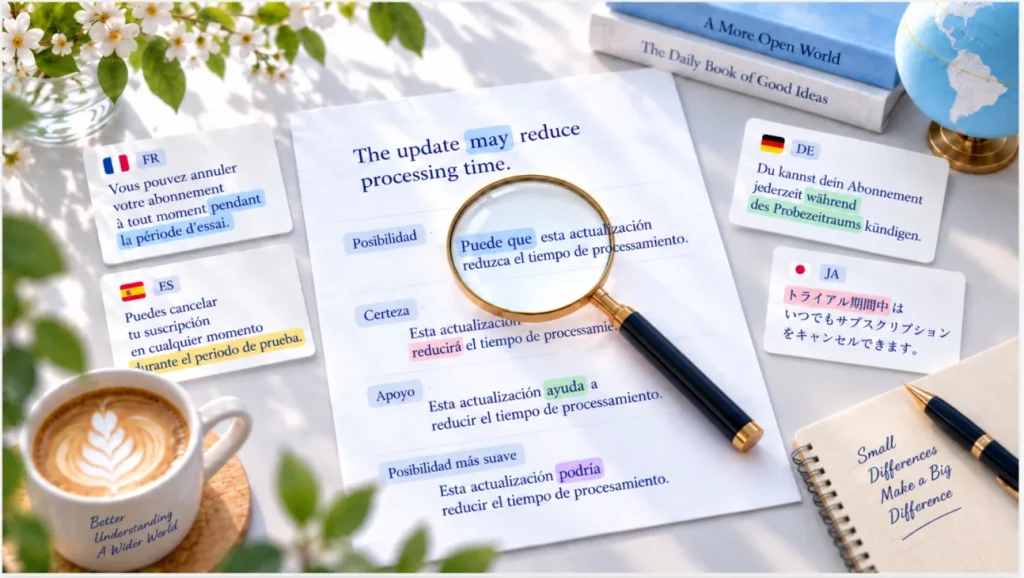
Consider the sentence The update may reduce processing time. If it becomes “The update will reduce processing time,” the translation still sounds perfectly reasonable, but may has become will, turning a possibility into a much stronger claim. For casual reading, that difference may not matter much. In technical documentation, research material, business communication, or product information, however, a small change in certainty can affect how someone understands or acts on the information.
That is why translation quality should not be judged only by how fluent the result sounds. A more useful question is: What will this translation be used for, and has any important part of the original meaning changed?
Start with what the translation will be used for
Not every translation needs the same level of review. If you are reading a news article, a forum discussion, or a general webpage, the main goal is usually comprehension. A slightly different word choice may not matter as long as the key facts, people, and conclusions remain clear.
The standard changes when the translation will be used for technical work, academic research, business communication, or publication. A small change involving a date, amount, condition, responsibility, or instruction can affect what someone does next. Legal, medical, and financial content requires even more care because the consequences of misunderstanding the source can be much greater.
| Use case | What is worth checking |
|---|---|
| News, forums, general webpages | Main facts and overall meaning |
| Technical documentation | Conditions, parameters, numbers, instructions |
| Research papers | Data, cause and effect, conclusions |
| Business communication | Dates, responsibilities, level of commitment |
| Long documents | Terminology, context, consistency |
| Legal, medical, or financial content | Critical facts and professional meaning; additional review may be needed |
A simple question can help you decide how much checking is necessary: If this part is translated incorrectly, could it change what I do next? If the answer is no, a line-by-line review is probably unnecessary. If the answer is yes, the translation deserves closer attention.
Some of the easiest mistakes to miss involve very simple words
Translation problems do not always come from difficult terminology. Some of the most consequential changes involve ordinary words such as may, only, must, unless, and at least. These small words can change whether something is possible, required, limited, or conditional, even though the rest of the sentence remains perfectly fluent.
For example, This feature is available only when synchronization is enabled. might be translated as “You can use this feature after enabling synchronization.” That sounds natural, but it weakens the original condition: the source says the feature is available only when synchronization is enabled. The same issue appears in Users may need to restart the application. If may need to becomes simply need to, a possible requirement has turned into a definite one.
Scope can change just as easily. If The feature is currently available to selected users. becomes “The feature is now available to users,” the translation is still easy to read, but selected users has disappeared. What originally applied to a limited group now sounds much broader. For important content, it is often more useful to check negation, conditions, degree, scope, timing, and who or what the sentence applies to than to inspect every individual word.
Numbers and terminology are good places to start
When a document is several pages long, comparing every sentence with the original is rarely practical. Numbers, dates, units, version numbers, names, and other fixed information are much easier to verify because they leave relatively little room for interpretation.
For example, Requests are limited to 100 per minute. could reasonably become “The service allows up to 100 requests per minute” or “Requests are limited to 100 per minute.” The wording can change, but 100, per minute, and the fact that this is a limit should not. The same principle applies to prices, percentages, dates, product names, API names, and model numbers.
Longer documents introduce another problem: terminology can drift. A term such as workspace might appear as “workspace” in one section, “work area” in another, and “working space” later on. None of those versions may look obviously wrong on their own, but inconsistent terminology can make readers wonder whether the document is referring to different concepts. A practical approach is to read the translation normally first, then make a quick second pass for numbers, names, and a small set of important terms.

If something looks uncertain, compare another translation
Looking at another translation can be useful when one sentence does not seem quite right, but the goal is not to let several tools “vote” on the answer. Agreement between multiple translations is not proof that a version is correct; what matters more is where the results disagree.
Imagine that the same sentence produces “Users must enable this option,” “Users should enable this option,” and “Users only need to enable this option under certain conditions.” The important signal is not which version appears most often. It is the fact that the translations disagree about the condition and strength of the requirement, which tells you exactly where to return to the source text.
By contrast, if several results differ only between phrases such as “enable synchronization,” “turn on synchronization,” and “activate synchronization,” while the condition and meaning remain the same, there may be little reason to keep comparing them. The value of another translation is therefore not simply that you get another answer; it helps reveal where the meaning may actually be uncertain.
If you are still deciding between GPT, Gemini, Claude, DeepSeek, DeepL, Google Translate, and other options, you can also read our AI translation model comparison. Choosing a translation tool and deciding whether a particular translation is reliable are related questions, but they are not the same one.
Comparing multiple translations can become work of its own
Comparing one or two sentences manually is easy. Comparing several versions of a long paragraph, email, report, or document quickly becomes tedious. Some sentences may be almost identical across every result, others may differ only in style, and only a few may contain differences that actually affect the meaning.
SelectTranslate’s Optimal Translation is designed for this kind of situation. It lets you compare multiple translations and narrow down the parts that deserve closer attention through scoring, sentence-level comparison, and result analysis. The score itself should not be treated as proof that one translation is objectively correct; it is better understood as a way to reduce the amount of comparison you have to do manually.
Suppose a five-sentence paragraph produces nearly identical translations for the first four sentences, while the fifth differs between must, should, and may. That final sentence is where your attention is most useful. Instead of rereading several complete translations, you can focus on the places where the meaning may actually have changed.
Summary
As AI translation becomes more fluent, some of the hardest mistakes to notice are the ones that do not look like mistakes at all. A translation can read smoothly while quietly changing a condition, level of certainty, scope, number, or subject. That is why fluency alone is not a reliable measure of accuracy.
You also do not need to verify every translation word by word. Start with how the content will be used, then check the information that would matter if it changed. If a sentence still seems uncertain, compare another result and look for meaningful disagreement.
Fluency tells you whether a translation reads well. Accuracy tells you whether the original meaning stayed intact.
Frequently Asked Questions (FAQ)
If an AI translation sounds natural, does that mean it is accurate?
Not necessarily. Natural wording tells you that the translated sentence reads smoothly, but it does not guarantee that conditions, scope, numbers, or the subject of the original sentence have been preserved. Some of the hardest translation mistakes to notice are the ones that still sound completely natural.
Do I need to check every sentence when translating a webpage?
Usually not. If you are reading news, forums, or general webpages simply to understand the content, getting the main meaning right is often enough. More detailed checking becomes worthwhile when the translation affects an action, publication, communication, or decision.
Does comparing several translations make the result more accurate?
Not automatically. Multiple translations are most useful because they expose disagreements. If the results differ only in wording, there may be nothing important to investigate; if they disagree about a condition, number, subject, or conclusion, that is a good reason to return to the original.
Can AI translation be used for research papers, contracts, or professional documents?
It can be useful for reading, understanding, and drafting, but the more specialized or consequential the content is, the less appropriate it is to rely on automatic translation alone. Important data, research conclusions, contractual obligations, and specialized terminology should be reviewed according to how the translated content will be used.
Is the highest-scoring Optimal Translation result always the correct one?
No. A score can help narrow down the results worth comparing, but it should not replace judgment based on the original text and its context. For important content, the final decision should still be based on whether the translation preserves the intended meaning.