
For medical students around the world, reading English medical literature has become an essential part of studying, research, and clinical training.
Whether you’re searching PubMed for the latest publications, reading journals like Nature, The Lancet, The New England Journal of Medicine (NEJM), JAMA, or BMJ, reviewing international clinical guidelines, or taking online courses from leading medical schools, English remains the primary language of modern medical knowledge.
The biggest challenge, however, isn’t necessarily your English level.
It’s how inefficient the reading process can be.
Many medical students spend hours switching between research papers and translation websites. They copy and paste paragraphs into translators, struggle with poorly formatted PDF files, and manually translate labels inside pathology images, CT scans, statistical figures, or laboratory diagrams.
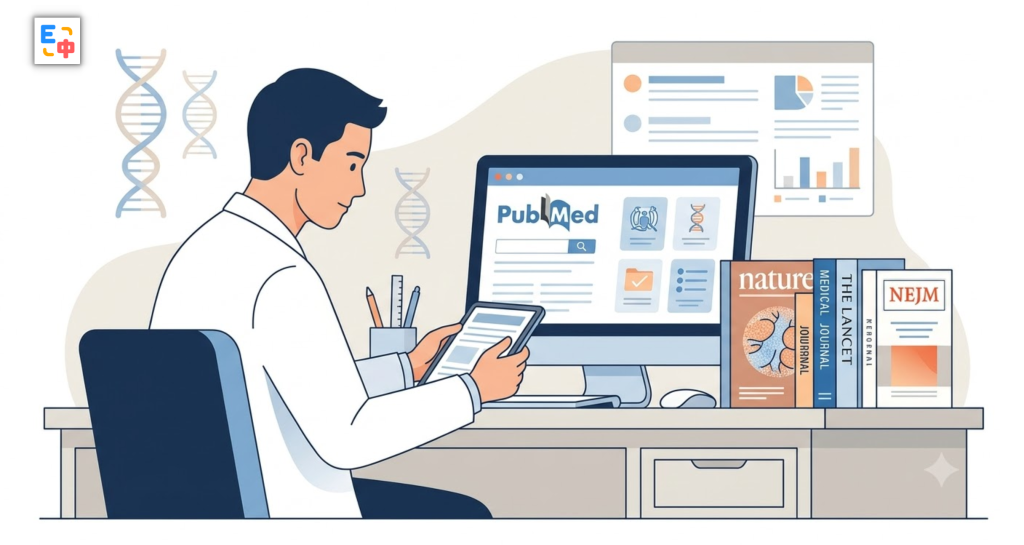
Ironically, much of the time isn’t spent learning medicine—it’s spent wrestling with translation tools.
That’s why more and more students are looking for a free translation extension that fits naturally into their entire research workflow instead of solving just one problem.
SelectTranslate is designed exactly for these real-world learning scenarios. It combines webpage translation, PDF document translation, image translation, selection translation, and AI-powered contextual translation into a single browser extension, allowing medical students to understand English literature while they read instead of constantly interrupting themselves to translate.
If you’re looking for a translation tool built specifically for studying, research, and academic reading, here’s why so many medical students are choosing SelectTranslate.
Why Reading Medical Literature Is More Challenging Than General English
Many people assume that improving English proficiency automatically makes medical papers easier to understand.
In reality, medical English is a completely different language.
Scientific papers contain highly specialized terminology, complex sentence structures, and domain-specific expressions whose meanings depend heavily on context.
For example:
- Positive may refer to a positive laboratory result rather than something favorable.
- Significant often means statistically significant, not simply important.
- Sensitivity and specificity have precise diagnostic meanings that differ from their everyday usage.
Literal translation frequently misses these nuances and can lead to misunderstandings of the entire study.
Medical students also work with a wide variety of content every day, including:
- PubMed articles
- Nature, Cell, and Science journals
- PDF research papers
- Medical textbooks
- Clinical practice guidelines
- Meta-analyses
- Cochrane Reviews
- Lecture slides
- Pathology images
- Experimental workflow diagrams
- Photos taken during lectures or laboratory sessions
These resources span web pages, PDF documents, and images.
Most translation tools only handle one of these formats well.
An ideal free translation extension should support the entire reading experience—not just webpage translation.
Scenario 1: Read PubMed, NEJM, and Nature Articles More Efficiently with Webpage Translation
Almost every medical student relies on PubMed.
But after opening an article, many people still read it like this:
Copy one paragraph.
↓
Open a translation website.
↓
Paste the text.
↓
Read the translation.
↓
Go back to the paper.
↓
Repeat dozens of times.
This constant context switching breaks concentration and dramatically slows reading.
With SelectTranslate, entire webpages can be translated directly inside your browser while preserving the original layout.
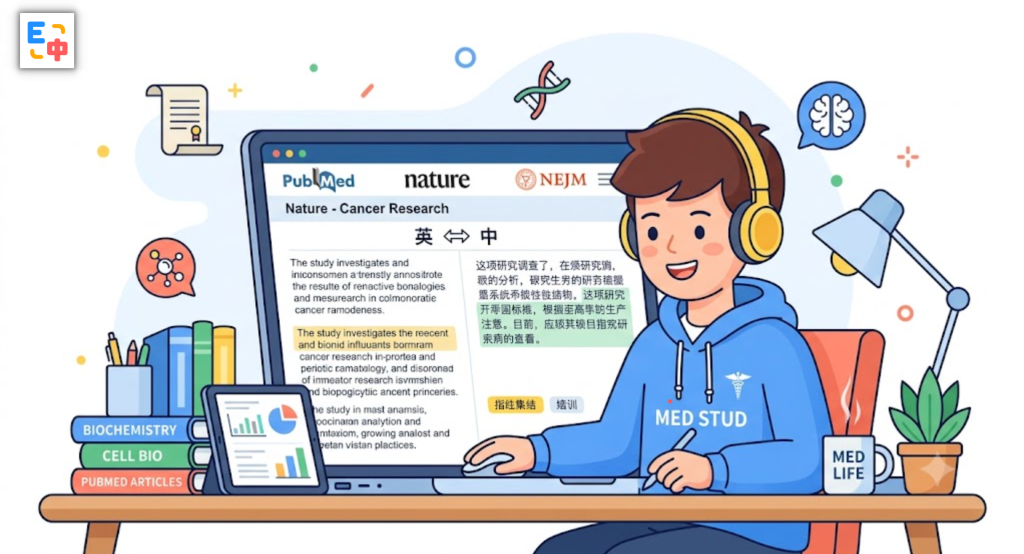
Its bilingual reading mode displays the original English text alongside the translation, making it much easier to compare both versions naturally.
Whenever you encounter unfamiliar terminology, you can simply highlight a word, sentence, or paragraph to receive an AI-powered contextual translation without leaving the page.
Instead of interrupting your reading every few minutes, you stay focused on understanding the research itself.
Scenario 2: Reading PDF Research Papers Without Formatting Headaches
While online articles are common, PDF files remain the standard format for scientific publishing.
Medical students regularly download:
- Original research papers
- Systematic reviews
- Clinical guidelines
- Medical textbooks
- Review articles
- Randomized controlled trials
- University lecture notes
Unfortunately, PDFs are also where many translation tools fail.
Common issues include:
- Broken two-column layouts
- Misplaced figures
- Unreadable tables
- Corrupted mathematical equations
- OCR recognition errors
- Missing page formatting
Sometimes the translated document becomes harder to read than the original.
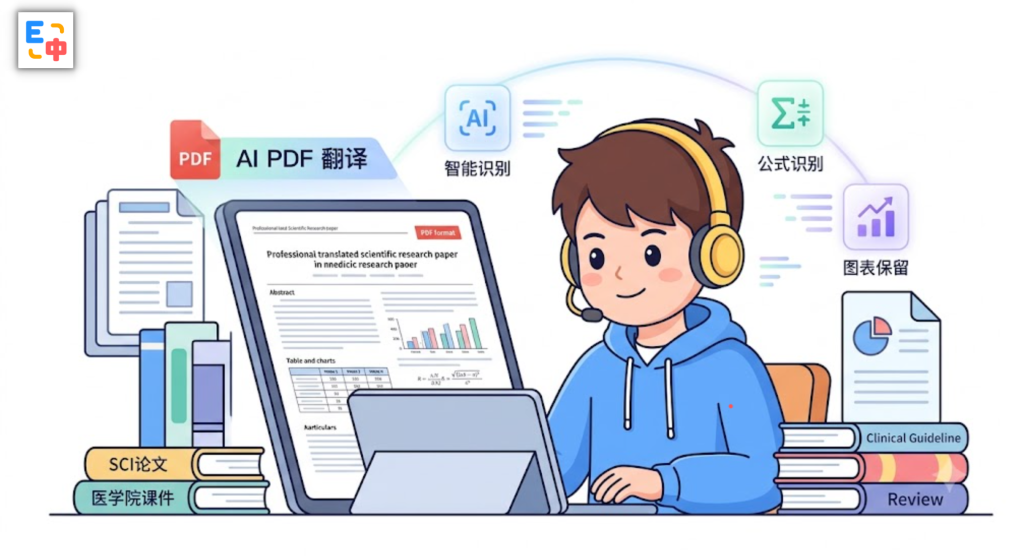
SelectTranslate includes AI-powered PDF translation that intelligently recognizes complex layouts, including multiple columns, tables, charts, figures, formulas, and embedded images while preserving the original document structure as much as possible.
For students preparing for exams, conducting literature reviews, writing dissertations, or participating in research projects, a reliable PDF translator can save countless hours.
Scenario 3: Translate Medical Images, Pathology Slides, and Laboratory Diagrams
Not all medical knowledge is written in paragraphs.
Much of it appears inside images.
Medical students frequently encounter:
- Anatomy illustrations
- Histology slides
- Pathology images
- MRI annotations
- CT scans
- Ultrasound images
- Western blot figures
- PCR workflow diagrams
- Cell signaling pathways
- Kaplan–Meier survival curves
- Forest plots
These images often contain important English labels that are difficult to understand quickly.
Traditional OCR software usually extracts only plain text and struggles to preserve the visual context.
With SelectTranslate’s image translation, you can translate English text directly inside medical images, diagrams, lecture screenshots, and textbook illustrations, making complex visual information much easier to understand.
Instead of repeatedly taking screenshots and copying text into separate OCR tools, everything happens within a much smoother workflow.
Scenario 4: Selection Translation Makes Reading Scientific Papers Much More Natural
Full-document translation isn’t always necessary.
Most of the time, you only need help with a few unfamiliar terms.
For example:
- Pharmacokinetics
- Pathophysiology
- Immunohistochemistry
- Odds ratio
- Hazard ratio
- Confidence interval
Copying and pasting every unfamiliar phrase quickly becomes frustrating.
With SelectTranslate, simply highlight any word, phrase, or paragraph to receive an instant AI translation that considers the surrounding context rather than translating words individually.
The experience feels much closer to reading naturally instead of constantly interrupting yourself.
Why AI Translation Works Better for Medical Literature
Recent advances in large language models have significantly improved scientific translation.
Traditional machine translation often focuses on sentence-by-sentence conversion.
Medical research, however, depends heavily on context.
For example:
Randomized controlled trial should be translated conceptually rather than literally.
Progression-free survival (PFS) refers specifically to a clinical endpoint measuring the length of time during and after treatment that a patient’s disease does not worsen.
Disease-free survival (DFS) represents another distinct clinical outcome with a precise medical definition.
These aren’t simply vocabulary problems—they require domain knowledge and contextual understanding.
SelectTranslate integrates multiple leading AI models to interpret scientific content more accurately, producing translations that better reflect how medical professionals actually communicate while reducing misunderstandings caused by overly literal translation.

Why More Medical Students Are Choosing SelectTranslate
What makes SelectTranslate different isn’t just translation quality.
It’s the fact that translation becomes part of your reading process instead of interrupting it.
From searching PubMed to reading PDF papers and analyzing medical figures, you rarely need to switch between multiple applications.
Medical students can:
- Translate entire research webpages while preserving formatting.
- Read bilingual versions of journal articles.
- Translate complex PDF documents with AI.
- Translate diagrams, pathology images, and lecture slides.
- Instantly translate unfamiliar terminology with selection translation.
Instead of relying on several separate tools, everything is integrated into one seamless workflow.
More Than a Free Translation Extension—A Better Way to Learn Medicine
AI is changing how medical students learn.
The real challenge today is no longer finding research papers.
It’s understanding them efficiently.
Every scientific article may contain dozens of unfamiliar terms, multiple statistical figures, complex diagrams, and pages of dense academic writing.
Traditional translation methods waste valuable study time and constantly interrupt concentration.
By combining webpage translation, AI-powered PDF translation, image translation, selection translation, and contextual AI understanding, SelectTranslate helps transform English literature from a language barrier into a practical learning resource.
Whether you’re preparing for medical school exams, conducting literature reviews, writing research papers, or simply keeping up with the latest clinical evidence, SelectTranslate allows you to spend less time translating and more time learning.
If you’re searching for a free translation extension built for medical education and scientific research, SelectTranslate deserves a place in your everyday study toolkit.
Because ultimately, the goal isn’t just to translate English—it’s to understand the world’s latest medical knowledge faster, think more deeply, and stay connected with advances happening across the global medical community.