
Reading foreign-language legal materials is a routine part of the work for law students, lawyers, in-house counsel, compliance professionals, and practitioners involved in cross-border business. Whether you’re reviewing overseas case law, international treaties, cross-border regulatory frameworks, English-language contracts, prospectuses, privacy policies, or industry compliance documents, language is only one part of the challenge.
The real difficulty lies in the nature of legal writing itself. Legal texts are highly precise, terminology-heavy, and syntactically complex. Even a minor translation error can lead to misunderstandings, flawed legal analysis, or incorrect practical decisions.
SelectTranslate is an AI-powered translation tool built for demanding reading scenarios like these. It supports a wide range of content formats, including webpages, PDFs, Word documents, Markdown files, and video subtitles. It also offers bilingual webpage translation, document translation, PDF Plus, selection translation, hover translation, and input translation.
For law students and legal professionals, the value of SelectTranslate goes far beyond simply translating foreign languages into Chinese. It helps users read, compare, and understand foreign legal materials more efficiently and accurately while preserving the original context and legal meaning.

Why Is Reading Foreign-Language Legal Materials So Challenging for Law Students and Legal Professionals?
Reading legal materials in a foreign language is fundamentally different from reading news articles, blog posts, or product documentation. Legal texts demand precision, consistency, and contextual understanding. In many cases, the literal meaning of a sentence is not enough to fully grasp its legal implications.
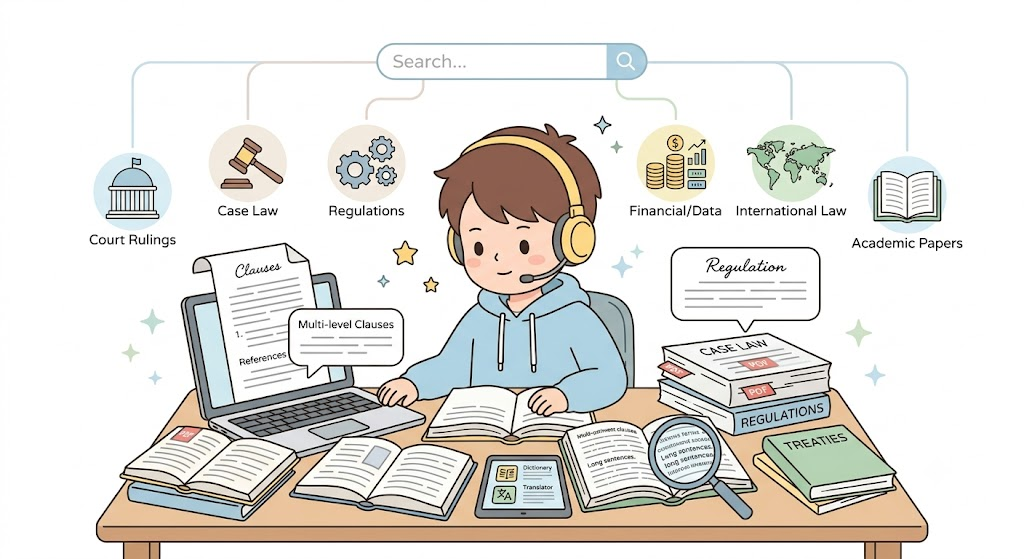
For example, law students writing research papers often need to consult case law, statutes, white papers, and academic journals published in the United States, the United Kingdom, the European Union, or by international organizations. Lawyers handling cross-border matters may need to review foreign court judgments, international dispute resolution rules, and commercial arbitration documents. Meanwhile, in-house counsel and compliance professionals frequently work with English-language materials related to data protection, antitrust law, financial regulation, export controls, intellectual property, and employment compliance.
Despite the variety of sources, these materials tend to present several common challenges.
The first challenge is legal terminology. Many legal terms cannot be interpreted in the same way as ordinary English vocabulary. Words such as consideration, injunction, tort, equity, fiduciary duty, due process, and material adverse effect carry specialized legal meanings that may vary across jurisdictions and legal contexts. A generic machine translation may produce a fluent translation, but not necessarily a legally accurate one, increasing the risk of misunderstanding.
The second challenge is sentence complexity. Legal documents frequently contain multiple subordinate clauses, conditional provisions, exceptions, and cross-references. A single sentence may span several lines or even an entire paragraph. When readers rely solely on a translated version, it can be difficult to determine whether important conditions, parties, liabilities, or exceptions have been omitted or interpreted incorrectly.
The third challenge is fragmented information sources. Law students and legal practitioners often switch between legislation databases, court websites, international organizations, regulatory agencies, academic platforms, and corporate disclosure portals. Constantly copying text into a translation tool and switching back to the original webpage disrupts concentration and significantly reduces reading efficiency.
The fourth challenge is document formatting. Court judgments in PDF format, scanned documents, two-column academic papers, contract appendices, tables, footnotes, annotations, and reference lists can all complicate the translation process. In legal research, formatting itself is often meaningful, as clause numbering, document structure, footnotes, and citation relationships all contribute to the accurate interpretation of legal materials.
How Does SelectTranslate Help Legal Professionals Read Foreign-Language Legal Materials More Efficiently?
SelectTranslate is designed for a “read while you understand” workflow, making it well suited for legal research and professional practice. It supports a wide range of scenarios, including bilingual webpage translation, document translation, PDF translation, video subtitle translation, online meeting translation, and ePub eBook translation. Powered by multiple AI translation models, it supports translation between more than 100 languages. For law students and legal professionals, SelectTranslate addresses not just the challenge of translation itself, but also the broader issues of reading efficiency and translation accuracy throughout the entire research process.
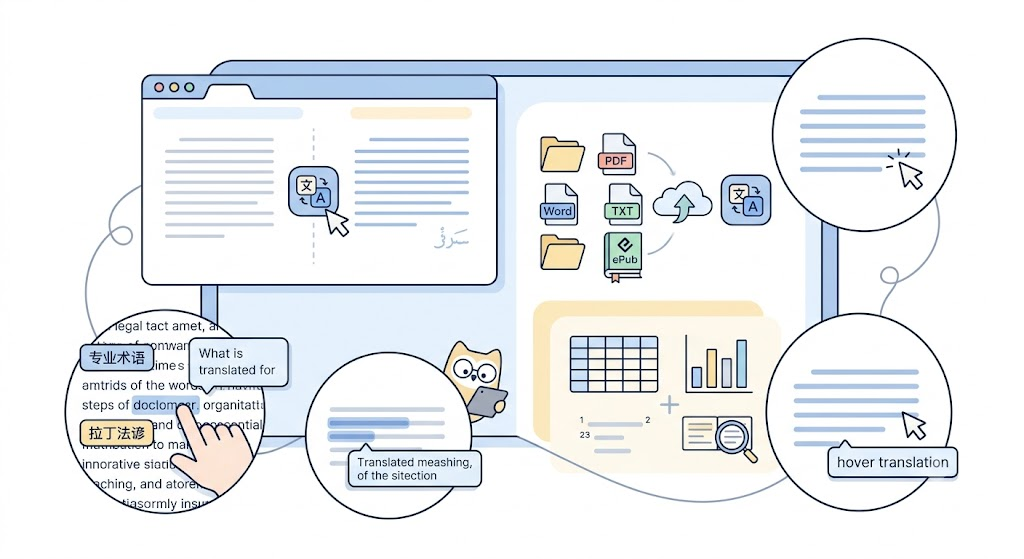
When users open a foreign-language webpage, they can activate SelectTranslate’s bilingual webpage translation feature. The extension automatically recognizes the webpage content and displays the translation directly beneath the original text. This allows users to read the source text and its translation side by side without leaving the webpage or repeatedly copying and pasting content into separate translation tools.
When working with PDFs, Word documents, TXT files, Markdown documents, SRT subtitles, or ASS subtitle files, users can take advantage of SelectTranslate’s document translation feature. For legal papers, contracts, court judgments, regulatory reports, compliance guidelines, and other professional documents, this approach minimizes formatting issues caused by manual copy-and-paste while preserving the original document structure for side-by-side comparison.
For more complex documents—such as academic papers, scanned PDFs, multi-column layouts, tables, diagrams, or formula-rich files—SelectTranslate’s PDF Plus feature provides more advanced document recognition. Although legal documents rarely contain mathematical formulas, they often include tables, footnotes, annotations, charts, and scanned pages. Examples include annual reports published by regulatory agencies, cross-border compliance white papers, and scanned court judgments. By accurately recognizing complex layouts, PDF Plus makes these documents significantly easier to read and analyze.
Whenever users encounter an unfamiliar word, phrase, or sentence, they can use the Selection Translation feature. Law students reading case law frequently come across specialized legal terminology or Latin legal maxims, while lawyers reviewing contracts may need to quickly verify the precise meaning of a clause within its specific context. Selection Translation enables users to obtain an accurate translation instantly without interrupting their reading flow.
For situations where translating an entire webpage is unnecessary, SelectTranslate also offers Hover Translation. Simply hovering the mouse over a paragraph displays its translation immediately. This feature is particularly useful for quickly scanning lengthy legal documents, identifying relevant sections, or conducting preliminary legal research before performing a more detailed analysis.
Bilingual Translation Addresses the Most Critical Challenge in Legal Reading
For legal texts, bilingual reading is far more valuable than translation alone. The goal of legal reading is not simply to understand the general meaning, but to accurately identify the parties involved, their rights and obligations, the scope of liability, applicable conditions, exceptions, and the legal consequences set out in the original text.
SelectTranslate’s bilingual webpage translation feature displays the translation directly beneath the source text, allowing readers to retain constant access to the original language. For law students, this means they can study foreign case law while gradually building their legal English vocabulary and familiarity with legal drafting. For lawyers and in-house counsel, it enables them to understand documents more efficiently while instantly referring back to the original wording whenever they need to verify a critical clause. For compliance professionals, it reduces the risk of overlooking important qualifications in regulatory documents that might be lost when relying solely on a translated version.
For example, when reading EU data protection regulations, U.S. securities regulations, or judgments from UK courts, it is common to encounter qualifying expressions such as provided that, unless otherwise specified, subject to, notwithstanding, and to the extent that. These seemingly small phrases often determine how a legal provision should be interpreted or applied. If readers rely only on the translation, they may overlook the legal significance of these qualifications. With bilingual reading, users can immediately compare the translated text with the original English sentence and evaluate how these expressions affect the legal meaning.
This is what makes SelectTranslate particularly valuable for legal professionals. Rather than encouraging users to rely entirely on the translation, it helps them engage with the original legal text more efficiently, while providing the linguistic support needed to understand it with greater confidence and accuracy.
Bilingual Reading Solves the Biggest Challenge in Understanding Legal Texts
When it comes to legal documents, bilingual reading is far more valuable than translation alone. The objective is not merely to grasp the general meaning, but to accurately interpret the parties involved, their rights and obligations, the scope of liability, applicable conditions, exceptions, and the legal consequences expressed in the original text.
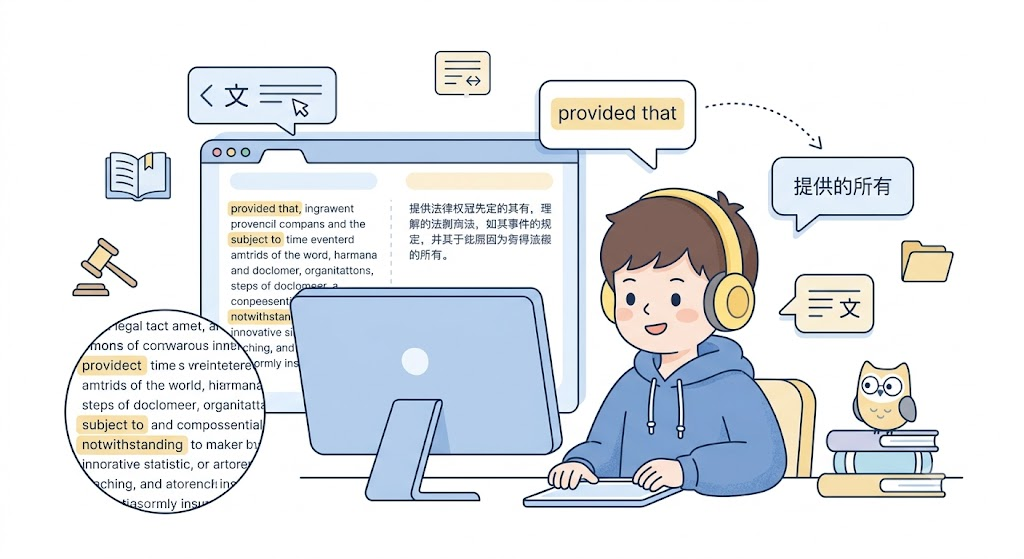
SelectTranslate’s bilingual webpage translation feature displays the translation directly beneath each paragraph of the original text, allowing readers to compare both versions without leaving the page. This gives users continuous access to the source language while benefiting from AI-assisted translation.
For law students, bilingual reading makes it easier to study foreign case law while building legal English proficiency and becoming familiar with authentic legal drafting. For lawyers and in-house counsel, it enables faster document review while allowing them to verify key clauses against the original wording whenever necessary. For compliance professionals, it helps ensure that important qualifications and limitations in regulatory documents are not overlooked by relying solely on a translated version.
For example, when reviewing EU data protection regulations, U.S. securities filings, or judgments from UK courts, readers frequently encounter qualifying phrases such as provided that, unless otherwise specified, subject to, notwithstanding, and to the extent that. Although these expressions may appear minor, they often determine the legal effect, scope, or applicability of a provision. Reading only the translated text can make it easy to miss these nuances. With bilingual reading, users can instantly compare the Chinese translation with the original English sentence and accurately assess how these qualifying phrases affect the legal interpretation.
This is what makes SelectTranslate especially valuable for legal professionals. Rather than replacing the original text, it helps users engage with it more efficiently—combining the speed of AI translation with the precision that legal research and practice demand.
When researching materials published by international organizations, legal professionals often need to review treaties, policy reports, dispute resolution documents, and intellectual property regulations. SelectTranslate helps users navigate multilingual resources more efficiently, reducing the time and effort required for cross-language legal research.
Recommended Legal Resources to Read with SelectTranslate
Law students and legal professionals can use SelectTranslate alongside a wide range of authoritative legal websites and research platforms.
For U.S. legal research, valuable resources include the Supreme Court of the United States, Congress.gov, the U.S. Securities and Exchange Commission (SEC), and CourtListener. These platforms are widely used for case law research, securities regulation, corporate disclosure, and studying the U.S. legal system.
For UK legal materials, users can access legislation.gov.uk and the British and Irish Legal Information Institute (BAILII). These websites provide comprehensive resources for researching UK legislation, common law, and judicial decisions.
For European Union law, EUR-Lex is the official database for EU legislation, directives, case law, and other legal documents. It is an essential resource for anyone researching data protection, digital markets, artificial intelligence regulation, competition law, consumer protection, and other areas of EU law.
For international law and international organizations, useful resources include the World Intellectual Property Organization (WIPO), the World Trade Organization (WTO), the United Nations Commission on International Trade Law (UNCITRAL), and the International Court of Justice (ICJ). These platforms are widely used for research in intellectual property, international trade, international commercial arbitration, public international law, and international dispute resolution.
For human rights research, the HUDOC database of the European Court of Human Rights provides access to judgments and legal materials concerning human rights law, procedural fairness, privacy, freedom of expression, and the limits of governmental authority.
For intellectual property and patent research, in addition to WIPO, users can consult the European Patent Office (EPO) and the United States Patent and Trademark Office (USPTO). Lawyers, patent attorneys, and corporate IP professionals can use SelectTranslate to read patent specifications, examination guidelines, case decisions, and policy documents more efficiently.
What these resources have in common is that they are highly authoritative, rich in legal information, and primarily available in English or multiple languages. At the same time, they can be difficult to navigate for readers working in a second language. With SelectTranslate’s bilingual reading mode, users can understand the content without leaving the original webpage while easily referring back to the source text whenever they need to verify important legal details. This makes legal research both faster and more accurate.
Who Is SelectTranslate Designed For?
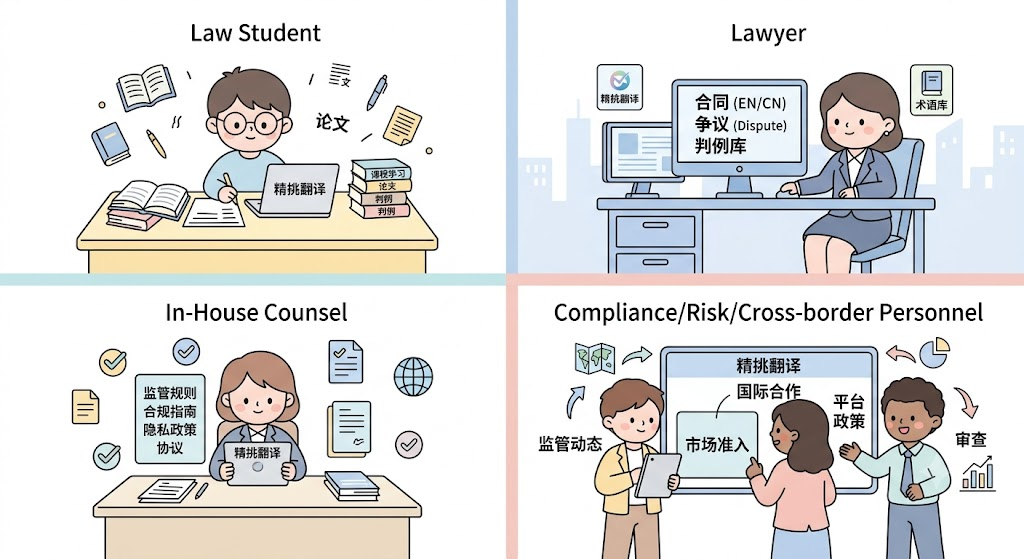
Law Students
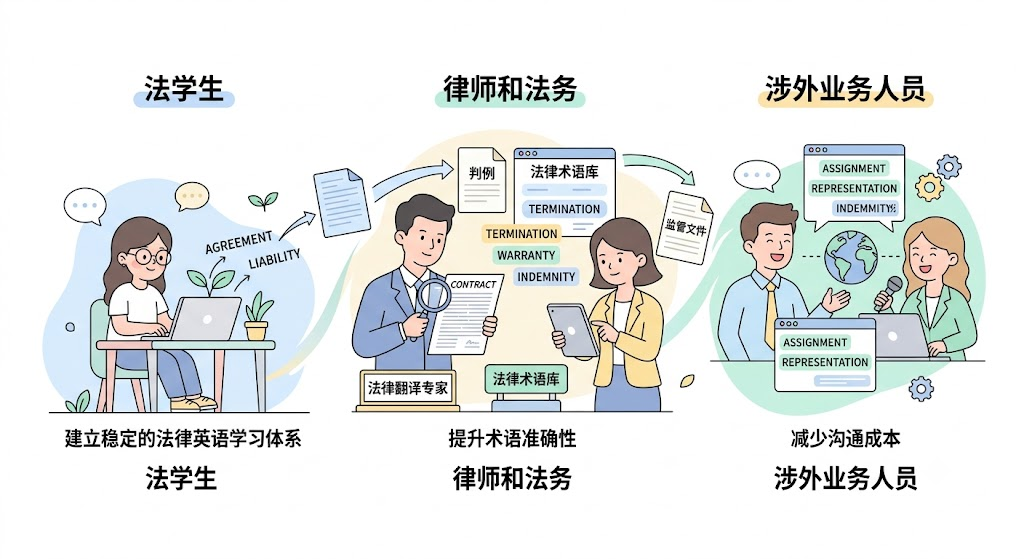
For law students, SelectTranslate is ideal for coursework, academic writing, comparative law research, reading foreign case law, and developing legal English skills. It helps students immerse themselves in authentic legal materials instead of being slowed down by unfamiliar vocabulary and lengthy legal sentences.
Lawyers
For practicing lawyers, SelectTranslate is well suited for reviewing cross-border contracts, researching international disputes, analyzing foreign case law, reading arbitration materials, and conducting industry research for clients. Features such as bilingual reading, Selection Translation, and customizable legal terminology support help lawyers strike a better balance between efficiency and accuracy.
In-House Counsel
For in-house legal teams, SelectTranslate is an effective tool for reviewing overseas regulations, English-language agreements, compliance guidance, privacy policies, supplier documentation, public company filings, and industry white papers. When dealing with large volumes of foreign-language materials, legal teams can quickly screen documents using AI translation before conducting a detailed legal review of key sections.
Compliance, Risk Management, and Cross-Border Business Professionals
For compliance officers, risk management professionals, and teams involved in international business, SelectTranslate is useful for monitoring regulatory developments, understanding overseas market access requirements, reviewing platform policies, analyzing commercial terms, and communicating with international partners. It enables professionals without a language specialization to understand complex legal and regulatory documents more quickly and confidently.
How to Build a More Efficient Legal Research Workflow with SelectTranslate
A more efficient workflow for reading foreign-language legal materials might look like this: start with bilingual webpage translation to quickly scan foreign-language content and determine whether it is relevant. Then use Hover Translation or Selection Translation to examine important paragraphs, legal terminology, or specific clauses. If you’re working with PDFs, Word documents, contracts, or other legal files, use Document Translation to preserve the original structure while reading. For highly specialized legal materials, switch to the Legal Translation Expert and apply a custom Legal Termbase to ensure consistent translation of key legal concepts. Finally, return to the original text and manually verify any provisions, definitions, exceptions, or liability clauses that could affect legal interpretation or decision-making.
The purpose of this workflow is not to replace legal judgment with AI. Instead, it allows AI to help users access foreign-language materials more quickly, identify relevant information, understand the context, and reduce language barriers. In legal practice, accuracy must always come first. SelectTranslate’s bilingual reading approach preserves direct access to the original text, making careful verification possible whenever it matters.
Conclusion: Legal Research Requires More Than Translation—It Requires a Reliable Reading Assistant
Foreign-language legal materials are typically highly specialized, information-dense, and demand a high level of accuracy. While conventional translation tools may help readers understand the general meaning, legal research requires much more: side-by-side access to the original text, consistent legal terminology, contextual accuracy, and preservation of document structure.
SelectTranslate provides a comprehensive solution for reading foreign-language legal materials through features such as bilingual webpage translation, document translation, PDF Plus, Selection Translation, Hover Translation, the Legal Translation Expert, and a customizable Legal Termbase. Whether you’re studying foreign case law, researching international regulations, reviewing English-language contracts, or monitoring overseas regulatory developments, SelectTranslate helps reduce language barriers, improve research efficiency, and maintain confidence in your legal analysis by keeping the original text readily accessible.
For both legal education and legal practice, truly effective reading is not about replacing the original language with a translation. It is about creating a reliable connection between the source text and the translated text. That is exactly what SelectTranslate is designed to do, making it a practical AI translation tool for law students and legal professionals who regularly work with foreign-language legal materials.