
The hardest part of reading AO3 in another language is often not the story itself.
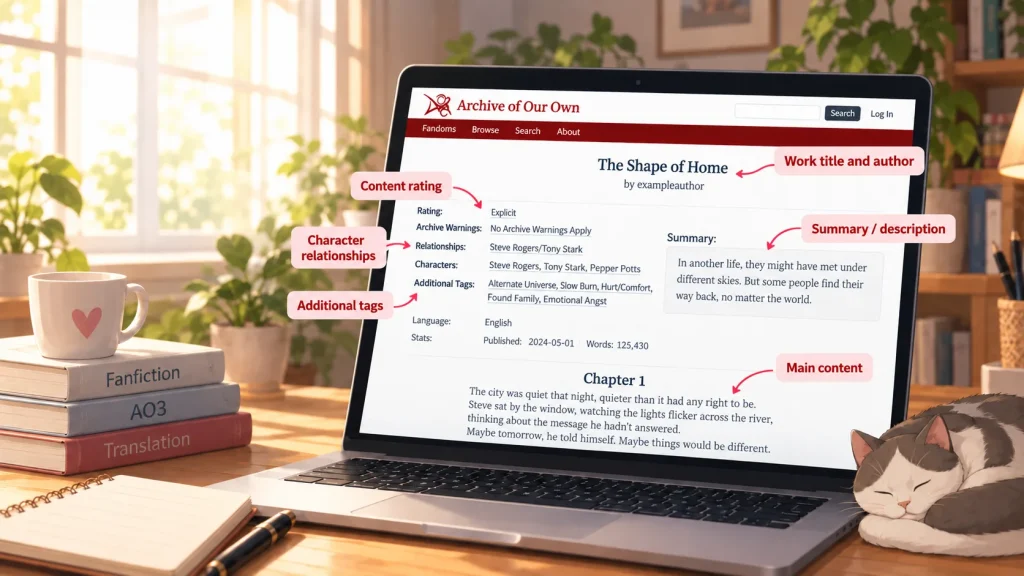
Before you even reach the first paragraph, you may already be looking at Rating, Archive Warnings, Relationship, Characters, Additional Tags, and Summary. Some of these labels are easy enough to understand on their own, but on AO3 they often carry fandom-specific meanings. Add ship names, character nicknames, AU terminology, fandom abbreviations, and freeform tags, and a literal translation may still leave you unsure what the fic is actually about.
Once you start reading, a different problem appears: length. A multi-chapter fic can run for tens or even hundreds of thousands of words. Copying a few paragraphs into a separate translator may be manageable for a short work, but doing that throughout a long fic quickly breaks the reading flow. Inconsistent translations of character names, ships, locations, or setting-specific terms can make things even more confusing.
So translating AO3 is not just about turning English text into another language. What really matters is whether you can understand the tags, keep names and fandom terminology consistent, and continue reading without constantly leaving the page.
For this kind of reading, SelectTranslate is more useful when it solves those specific problems rather than simply translating isolated sentences. A terminology glossary can help keep recurring character names, ship names, and setting terms consistent across a long work, while Smart Translation Expert is better suited to fandom expressions, unusual tags, and lines where a literal translation does not fully explain the meaning.
The fic itself can still be read directly on the AO3 page. You can focus on the translated text while following the plot, then refer back to the original when a ship name, tag, or line needs closer attention.
Start with the tags before reading the fic
An AO3 work page already tells you a lot before the story begins.
Summary gives you the basic premise, but Rating, Archive Warnings, Relationship, and Additional Tags often matter just as much when deciding whether a work is something you actually want to read.
Rating indicates the general content level. Archive Warnings highlights major content warnings. Relationship shows the central relationships, while Additional Tags may describe tropes, settings, emotional tone, plot elements, alternate universes, or the author’s own notes about the fic.
If you skip all of this and jump straight into the first chapter, you may get several pages in before realizing the work is very different from what you expected.
That is why translating AO3 is often easier when you first understand the work metadata, rather than treating the body text as the only part that matters.
A/B and A & B do not mean the same thing
One of the most important parts of an AO3 work page is the Relationship field.
For example:
Character A / Character B
and
Character A & Character B
may look almost identical, but they usually describe different kinds of relationships.
A slash / generally indicates a romantic or sexual pairing, while an ampersand & usually refers to a platonic, familial, friendship, or other non-romantic relationship.
If a translation only focuses on the character names and ignores the symbol between them, it can lose the most important part of the tag.
Ship names create a similar issue.
Many fandoms already have established ship names, abbreviations, and naming conventions. These are often used consistently across AO3, Tumblr, Reddit, X, fan wikis, and other communities. Translating every ship name into a completely different local-language form may make the current page easier to read, but it can make later searches much harder.
For that reason, character names, ship names, canon titles, and common fandom abbreviations often work better when the original form remains visible.
If you read the same fandom regularly, this is also where a terminology glossary becomes especially useful. Instead of letting the same character, organization, or ship name appear in several different translations across a long fic, you can define the preferred form once and keep it more consistent.
Additional Tags are often impossible to understand literally
Additional Tags are where many readers get stuck.
Common examples include:
slow burnhurt/comfortcanon divergencefix-it ficenemies to loversfriends to loversalternate universefound family
These are not just ordinary English phrases. Within fandom culture, many of them have established meanings.
For example, slow burn does not simply mean something that “burns slowly.” In fanfiction, it usually describes a relationship that develops gradually over a long period of time, often across many chapters.
fix-it fic is not literally a story about fixing something. It usually refers to fanfiction that rewrites a disappointing, tragic, or frustrating part of canon, such as a character death or an ending the author wants to change.
canon divergence means the story follows canon up to a certain point, then deliberately branches into a different timeline or outcome.
The difficulty here is not vocabulary. It is context.
When a translated tag still feels strange, it is often better to keep the original term visible and interpret it alongside the Summary, other tags, and the fic itself. If the literal translation still does not make sense, Smart Translation Expert is more useful for understanding what the phrase means in context than simply translating the same words again.
Freeform tags often sound more like the author talking to you
AO3 allows authors to create their own tags, which means the tag section often includes much more than standard trope labels.
You may see things like:
everyone needs therapy
no beta we die like men
author regrets nothing
this got out of hand
These may describe the story, but they may also be jokes, fandom memes, warnings, or casual comments from the author.
A machine translation can translate the words, but that does not always preserve the tone.
It is usually more useful to read these as part of the author’s voice rather than as formal categories. If the translated version sounds oddly literal, checking the original and interpreting the phrase in context is often more helpful.
This is another situation where Smart Translation Expert makes more sense than simply translating the full page again. The issue is no longer “what do these words mean?” but “what is the author actually implying here?”
Long fic becomes difficult when translation keeps interrupting reading
Copying a paragraph into a translator is not a major problem when a fic is only a few thousand words long.
Longfic is different.
An AO3 work may have ten, twenty, fifty, or more chapters, sometimes totaling hundreds of thousands of words. If you repeatedly select text, copy it, open another translation tool, read the result, and then return to AO3, the interruption becomes part of the reading experience.
The bigger problem is not the number of clicks. It is having to repeatedly recover your place and rebuild the context after switching away.
For longer works, it is much more practical to translate the text directly on the AO3 page.
With SelectTranslate, the story can stay in the original chapter layout while you continue reading in place. If your main goal is to follow the plot, you can focus on the translated text. When you reach a character name, unusual tag, or important line that needs checking, you can refer back to the original instead of leaving the page entirely.
For long-form reading, that continuity often matters more than optimizing every individual sentence.
Consistency matters more in longfic than perfect wording
Name and terminology consistency becomes much more noticeable in long works than in short excerpts.
A character may appear under a full name, surname, nickname, title, or a fandom-specific nickname. If those are translated inconsistently, one form may be transliterated, another translated literally, and another left in English.
Any one of those choices may be understandable in isolation. Across dozens of chapters, however, they can make the same character look like several different people.
The same applies to:
- ship names
- locations
- organizations
- abilities or powers
- canon terminology
- fictional species
- worldbuilding terms
This is where a terminology glossary is more valuable than it would be for a short article.
If you know the preferred translation or naming convention for recurring terms, you can define them in advance. That makes it easier to keep important names and setting terminology stable across the entire work.
The goal is not to force every proper noun into one translated form. It is to prevent recurring terms from changing unpredictably while you read.
You do not need bilingual text on screen all the time
It is easy to assume that original text plus translation is always the best way to read.
For long fanfiction, that is not necessarily true.
If you mainly want to follow the plot, seeing every paragraph twice can make the page feel much longer. Across dozens of chapters, reading both versions continuously can become tiring.
A more practical approach is to read mostly in translation, then return to the original when the specific content makes it useful.
That may include:
- a character’s first appearance
- ship names or unusual nicknames
- an important line of dialogue
- wordplay or jokes
- fandom-specific expressions
- a translation that sounds obviously unnatural
In other words, you do not have to choose between “always bilingual” and “translation only.”
Most of the story can be read in translation, while the original remains available when something needs closer attention.
If the problem is not the wording itself but a confusing fandom expression or context-heavy sentence, Smart Translation Expert can then be used for that specific part. If the problem is inconsistent character or setting terminology, the terminology glossary is the more relevant tool.
Different problems benefit from different solutions.
Do not skip the author’s Notes
AO3 works often include Notes before or after a chapter.
These can contain timeline explanations, character details, references to canon, content warnings, sources, or explanations of jokes and references used in the chapter.
Sometimes a line in the story seems confusing only because the explanation is sitting in the author’s note right above it.
So if part of a chapter feels unexpectedly difficult to understand, check the Notes before assuming the translation itself is wrong.
On AO3, the Summary, Tags, Notes, and story text often work together. Translating only the body text can mean missing context the author has already provided elsewhere on the page.
What should you translate, and what is better kept recognizable?
Different parts of an AO3 work benefit from different approaches.
| AO3 content | Recommended approach |
|---|---|
| Main story text | Read mainly in translation |
| General description | Translate normally |
| Character names | Keep a consistent preferred form |
| Ship names | Use established fandom naming where possible |
| Organization and setting terms | Add important recurring terms to a terminology glossary |
| Relationship tags | Preserve the characters and relationship symbols |
| Fandom abbreviations | Keep the original term when useful |
| Additional Tags | Translate, but check the original when meaning is unclear |
| Freeform author tags | Interpret with context rather than literally |
| Important dialogue | Compare with the original if nuance matters |
| Author’s Notes | Read together with the chapter |
The point is not to remove every foreign-language element from the page. It is to make the story easier to follow without losing the terms that still matter for understanding the fandom.
Final thoughts
AO3 is not difficult to translate because the English is necessarily more advanced than on other websites.
The real challenge is that a single work page combines story text, Relationship tags, ship names, fandom terminology, freeform tags, author Notes, and potentially hundreds of thousands of words of long-form reading.
Those parts do not all need to be handled in the same way.
The main story can usually be read primarily in translation. Character names, ship names, and recurring worldbuilding terms benefit from consistency, which is where a terminology glossary becomes useful. Fandom phrases, unusual tags, and context-heavy lines are better handled with deeper interpretation when a literal translation is not enough.
For AO3, SelectTranslate is therefore most useful not simply because it can translate a webpage, but because it supports the parts of long-form reading that become difficult over time: keeping important terminology consistent, understanding context-heavy expressions, and continuing to read without constantly leaving the page.
A good AO3 translation experience is not about making every English word disappear. It is about understanding the story while still keeping the names, ships, tags, and fandom language that give the work its original context.
FAQ
What should I do if I do not understand an AO3 Additional Tag?
Do not rely only on a literal translation. Many Additional Tags are established fandom terms, internet slang, or freeform author comments. Keep the original term visible and interpret it alongside the Summary, other tags, and story context. For expressions that remain unclear after translation, Smart Translation Expert can help with contextual interpretation.
Should AO3 ship names be translated?
Not necessarily. Many ship names and abbreviations already have established forms within fandom communities. If you plan to search for more works, fan art, or discussions later, keeping the commonly used original name is often more practical.
Why do character names sometimes change across a translated longfic?
A single character may appear under a full name, surname, nickname, title, or other form of address. Different sections may also produce different translations when processed independently. A terminology glossary can help keep recurring names and important setting terms more consistent.
Should I translate AO3 Notes too?
Usually, yes. Author Notes often contain timeline information, character context, warnings, references, or explanations that may clarify something in the chapter itself.
Should tags and story text be translated in the same way?
Not always. Story text is usually easier to read primarily in translation, while character names, ship names, Relationship tags, fandom abbreviations, and some Additional Tags are often easier to understand when the original wording remains available.