
Reading a lengthy article no longer means working through every paragraph yourself. With ChatGPT, Gemini, and AI-powered browsing assistants, you can get the main points in seconds, ask follow-up questions, and find information without manually searching an entire page.
That convenience is changing how people use the web. Instead of reading the original article first, we increasingly encounter a shortened version of it—one that an AI system has already interpreted and organized for us.
But there’s a catch: an AI summary can be accurate about the main story and still leave out the detail you actually need.
A real Google announcement and a major study of AI-generated news answers show why that distinction matters.
1. A Real Example: Google’s Own AI Summary Left Out a Key Requirement
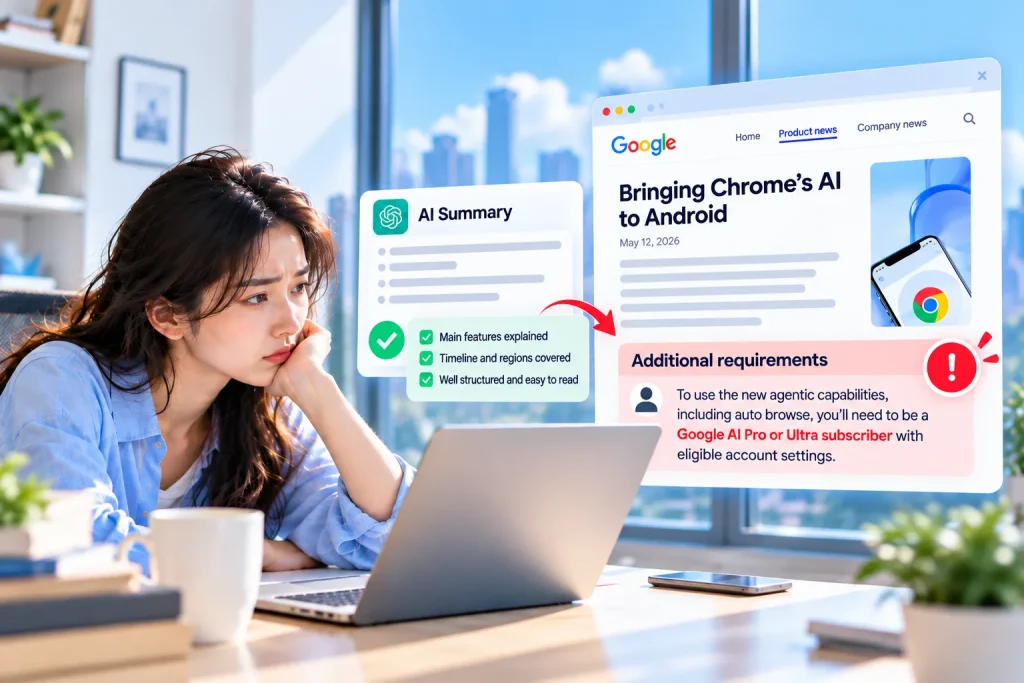
On May 12, 2026, Google announced that Gemini in Chrome was coming to Android, including features for understanding webpages and an automated browsing capability called Auto Browse.
The announcement included something especially relevant to this discussion: an AI-generated summary.
The summary described the upcoming features, the planned late-June rollout, and several device requirements. For someone following Google’s product announcements, it offered a useful overview.
But there was an important qualification missing from the summary.
Auto Browse wasn’t simply becoming available to every eligible Android user. It also required a qualifying Google AI Pro or AI Ultra subscription.
That distinction appeared in the full announcement, alongside the rollout and device requirements.
| What readers needed to know | What Google announced |
|---|---|
| Initial rollout | Starting at the end of June 2026 |
| Initial availability | United States, on selected devices |
| Android version | Android 12 or later |
| Device memory | At least 4 GB of RAM |
| Language setting | U.S. English |
| Auto Browse | Qualifying Google AI Pro or AI Ultra subscription required |
The AI-generated overview covered the main announcement, but not the subscription requirement for Auto Browse.
For a reader who simply wanted to know what was new in Chrome, that omission might not matter much.
For someone deciding whether they could actually use Auto Browse, it made a significant difference.
This is what makes the example interesting. The summary didn’t need to invent a feature or misstate the launch date to leave readers with an incomplete understanding. It only needed to exclude a condition that mattered to a particular decision.
The headline of an announcement and the details that determine whether it applies to you are not always the same thing.
The same problem can arise with product updates, subscription plans, eligibility rules, and service announcements. A summary may tell you what changed without telling you everything you need to do next.
2. If an AI Answer Includes Sources, Can You Trust It?
Missing details are one concern. Incorrectly interpreting or citing information is another.
In October 2025, the European Broadcasting Union (EBU) published an international study led by the BBC examining how AI assistants answered questions about news and current affairs.
The research involved 22 public-service media organizations across 18 countries and 14 languages. Professional journalists evaluated more than 3,000 responses from ChatGPT, Gemini, Copilot, and Perplexity.
The findings were significant.
| Finding | Share of evaluated responses |
|---|---|
| At least one significant issue | 45% |
| Serious sourcing problems | 31% |
| Major accuracy problems | 20% |
These categories overlap and should not be added together.
The problems included misleading or incorrect source attribution, unsupported claims, factual errors, and outdated information.
There’s an important distinction here: the study evaluated AI answers to news questions, not the accuracy of every AI-generated webpage summary. Its findings shouldn’t be presented as a universal error rate for summarization tools.
Still, the research highlights a relevant weakness in AI-assisted reading. An answer can sound authoritative and include references without accurately representing what those references say.
A citation is useful because it gives readers somewhere to check the claim. Its presence alone doesn’t establish that the claim is correct.
That matters even more when AI combines material from multiple sources. A product’s official documentation, a journalist’s review, and an individual user’s experience may all be relevant, but they don’t carry the same kind of evidence.
If an AI-generated answer blends those sources into one confident conclusion, the differences can become difficult to see.
3. How to Check an AI Summary Without Reading Everything
The answer isn’t to stop using AI summaries. They’re genuinely useful for scanning long articles, researching unfamiliar topics, and deciding which pages deserve more attention.
The more practical approach is to use AI to narrow down what you need to verify.
Ask for the details that affect your decision
Return to Google’s Android announcement.
If your only question is what’s new in Chrome, a general summary makes sense. But if you want to know whether Auto Browse is available to you, the question needs to be more specific.
Instead of asking:
Summarize this article.
Try:
Based on this announcement, identify the rollout date, supported devices, geographic restrictions, and subscription requirements for Auto Browse. Point me to the relevant passages, and mark anything the article doesn’t explicitly confirm.
This doesn’t guarantee an accurate answer. It does, however, make your information needs clearer and gives you specific claims to verify.
Rather than asking the AI to summarize everything, you’re asking it to find the information that could change your decision.
Check the passage that supports the answer
You rarely need to reread an entire article just to verify one detail.
For a product announcement, the relevant information may be in the availability section, a footnote, or the terms attached to a particular feature.
Pay special attention to dates, pricing, eligibility, regional availability, and exceptions. These are often the details that determine whether a general statement applies to your situation.
If the sources disagree, check when each was published. A feature may have moved from a limited preview to a wider rollout, making both announcements accurate for their respective dates.
What if the source is in a language you don’t understand?
AI can point you toward the right document, but checking the evidence becomes harder when the original is written in an unfamiliar language.
Imagine finding a useful Korean product announcement or a Japanese service update. The AI may identify a particular paragraph as the source of its answer, but you’re still left trying to understand exactly what that paragraph says.
This is where a webpage translation tool can serve a specific purpose.
With SelectTranslate, you can use hover translation to translate the relevant paragraph directly on the original webpage. On desktop, the feature is triggered by hovering over the text and holding the left mouse button or using the configured shortcut.
Instead of asking an AI assistant to generate another explanation of the same source, you can examine the translated passage in its original context.
Translation isn’t proof of accuracy, either. If a date, number, exception, or eligibility condition is particularly important, the original wording remains the final reference.
The benefit is straightforward: you can understand the evidence without having to translate an entire webpage or repeatedly copy text between tools.
4. When Is an AI Summary Enough?
Not every article needs the same level of scrutiny. The useful question is what you plan to do with the information.
| Your goal | A practical approach |
|---|---|
| Get the gist of a news story | Start with an AI summary |
| Find a specific detail in a long article | Ask AI to locate the relevant passage |
| Understand an unfamiliar concept | Ask for an explanation and check the context |
| Compare several sources | Keep track of publication dates and original sources |
| Confirm prices, dates, or eligibility | Verify the relevant official information |
| Understand a full argument or interview | Read the original content in full |
A short summary may be enough for casual browsing. If the information will influence a purchase, an application, or another meaningful decision, the standard should be higher.
It’s also worth remembering that some articles aren’t valuable merely because of their conclusions. A long interview, investigative report, or carefully argued essay may lose much of its meaning when reduced to bullet points.
AI can help you decide what deserves your attention. It doesn’t always preserve the experience or reasoning that makes the original worth reading.
5. Faster Answers Still Need Reliable Evidence
AI-powered browsers are making information easier to access. Tasks that once required opening several pages and comparing them manually can increasingly begin with a single question.
Google’s own announcement offers a particularly clear example of the trade-off. Its AI-generated summary captured the main news, but omitted a subscription condition that mattered to people interested in using Auto Browse.
The BBC-led EBU research highlights a different problem: in the news-answering tasks it examined, AI assistants frequently struggled with sourcing and factual accuracy.
Neither example means AI summaries are useless. Both suggest that getting an answer quickly and having enough reliable information to act on it are different things.
The best use of AI isn’t necessarily to read less. It’s to spend less time searching and more attention on the details that matter.
Use a summary to understand the topic. Ask targeted questions to find what you’re looking for. When the answer affects a real decision, check the original evidence.
As AI becomes a more familiar part of browsing, knowing when to return to the source may be just as valuable as knowing how to ask a good question.
Frequently Asked Questions
Can AI summaries leave out important information?
Yes. A summary can accurately capture an article’s main points while omitting conditions, exceptions, or other details relevant to a specific reader. Important decisions may require checking the source.
Does a citation make an AI-generated answer reliable?
Not necessarily. A source link may be incorrect, outdated, or insufficient to support the claim being made. Check whether the cited passage actually confirms the answer.
Can Gemini in Chrome summarize webpages?
Yes. Gemini in Chrome supports webpage summaries and questions about page content. Availability and specific capabilities depend on factors such as device, region, and account eligibility.
Should I use AI summarization or translate a foreign-language article?
It depends on your goal. Summarization can help you locate information quickly, while translation is more useful when you need to understand the actual source text. For important details, check the relevant original passage.